Is your brand mentioned by AI? Customers now ask ChatGPT instead of searching for websites
TMI Soft team, AI FDE Engineer8 min read
Quick summary
Whether your brand is mentioned by AI depends on what AI can read about your business across the web, not only on your own website. Customers click on individual websites less and less: they ask ChatGPT, or read the AI summary at the top of Google, and get a ready-made comparison of a few businesses compiled by AI. According to Pew Research (07/2025), when Google shows an AI summary, users click a search result in only 8% of visits, compared with 15% without one. AI search picks the names for that comparison based on whether it can read your website, whether your content answers customers’ questions directly, whether you are mentioned in other sources, and whether you have real reviews and a consistent profile everywhere.
Key takeaways
- Customers no longer look for each company themselves: they ask AI and get a comparison of a few names, and businesses not on that list are barely considered
- When Google shows an AI summary, the click rate on search results falls from 15% to 8% of visits (Pew Research, 07/2025)
- AI picks names from five groups: a website AI can read, content that answers customers’ questions directly, how often you are mentioned elsewhere (the strongest), real reviews, and the same profile everywhere
- You can check in 30 minutes: ask ChatGPT, Gemini and Google 10 questions real customers ask, and record whether AI names you and whether it is right
- There is no special technical trick for AI; what is needed is information that is complete, consistent and confirmed by real customers
For the past ten years, the customer journey was familiar: type a query into Google, look at the list of results, click a few websites, then compare on your own. A business only needed a good website and a spot on Google’s first page to have a chance of being chosen.
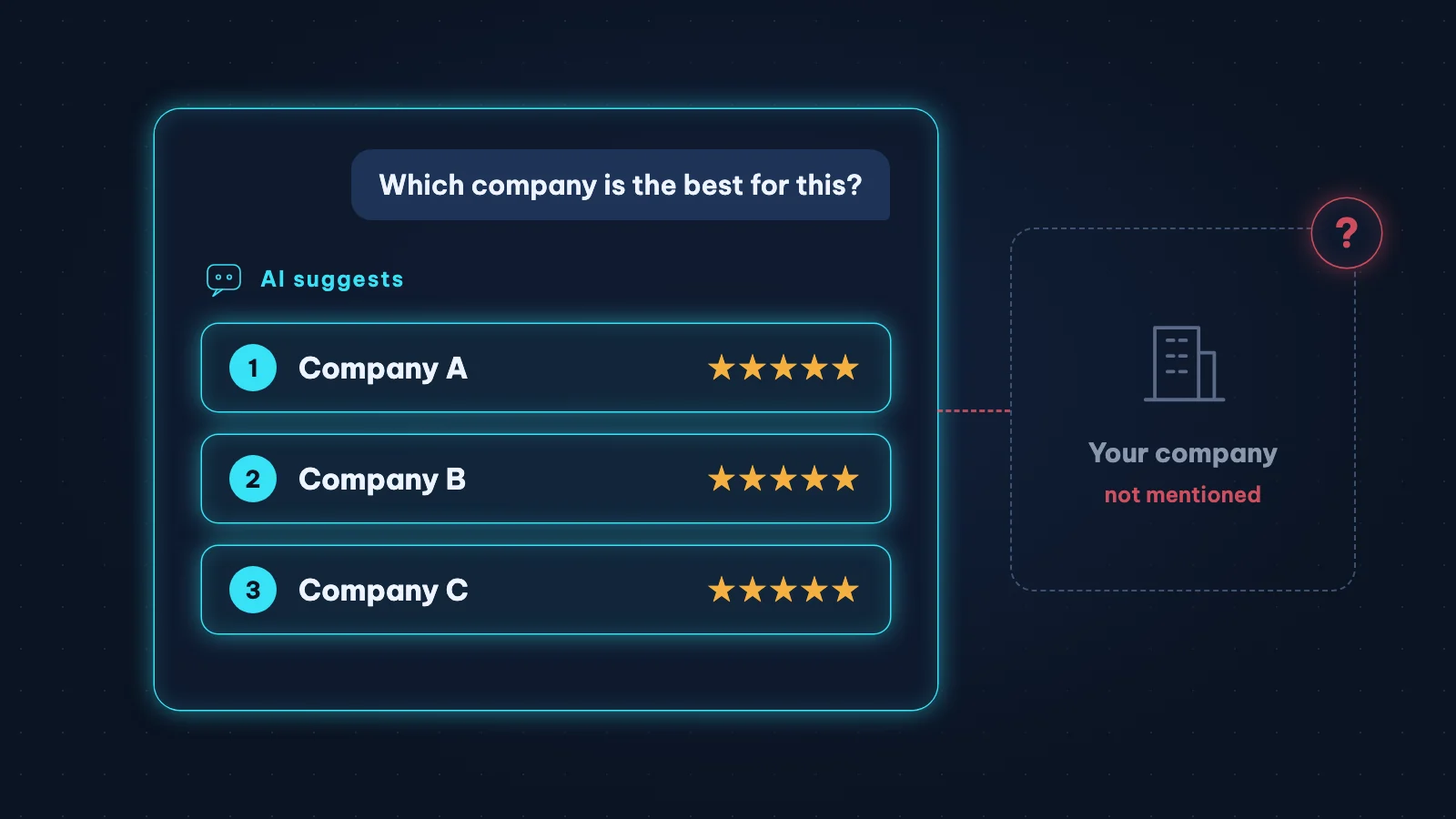
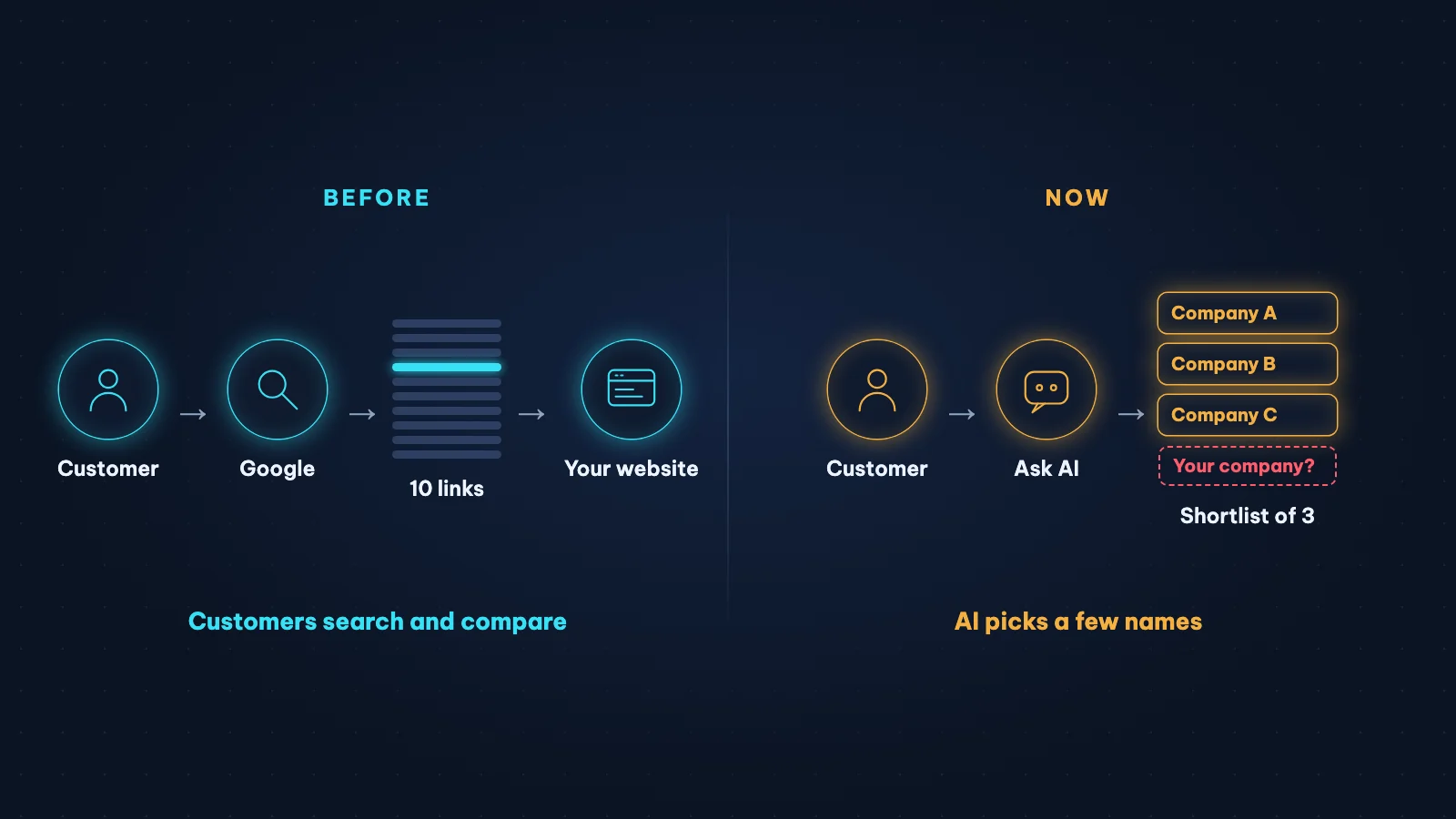
That journey is changing. More and more customers ask ChatGPT directly, “Which company in Hanoi is good at service X?”, or still use Google but only read the AI-written summary at the top of the page. They no longer go looking for your company. They receive a comparison of a few names compiled by AI, and decide from there.
So the question for every business leader is simple: is your brand mentioned by AI, or are you still waiting for customers to find your website on their own, as before?
How do customers find businesses now?
Customers now ask AI first, and only then look at the websites of the few names AI gives them. The figures below show this shift is already happening at a very large scale:
- Google’s AI summaries (AI Overviews) have more than 2 billion users a month, according to Google CEO Sundar Pichai’s remarks in the Q2 2025 earnings report.
- ChatGPT reached 800 million weekly users (OpenAI, 10/2025) and 900 million in 02/2026, according to TechCrunch.
- According to Pew Research (07/2025), when a Google page shows an AI summary, users click a search result in only 8% of visits, almost half the 15% seen without a summary. Links inside the summary itself are clicked in just 1% of visits.
- The BrightLocal (2026) consumer survey found that the share of people using ChatGPT and other AI tools to find local business recommendations rose from 6% to 45% in a single year, making AI the third most common source of recommendations.
These surveys were done in the US, but the trend in Vietnam points the same way: Google’s AI summaries already appear in Vietnamese, and ChatGPT and Gemini are familiar tools for office workers. The people making purchasing decisions for businesses are using them too.
What does “being mentioned by AI” mean for a business?
Being mentioned by AI means that when a customer asks a question related to your industry, your business name appears in the answer, along with an accurate description of what you do well. If you are not mentioned, then for that customer your business barely exists, however good your website looks.
The biggest difference from old-style search is that AI has already chosen for the customer. The old Google results page had ten links; customers scrolled and filtered on their own. An AI answer usually has only three to five names, with comments on the strengths and weaknesses of each. Anyone not on that shortlist never gets compared.
Second: AI does not only read your website. It pulls from many sources, including Google Maps reviews, news articles, forums, videos and comparison sites. If those sources say little about you, or say the wrong things, AI will repeat exactly that to customers.
What information does AI use to compare and mention a business?
AI picks names based on what it can read, and trust, about a business. There are five groups of information a business should look after:
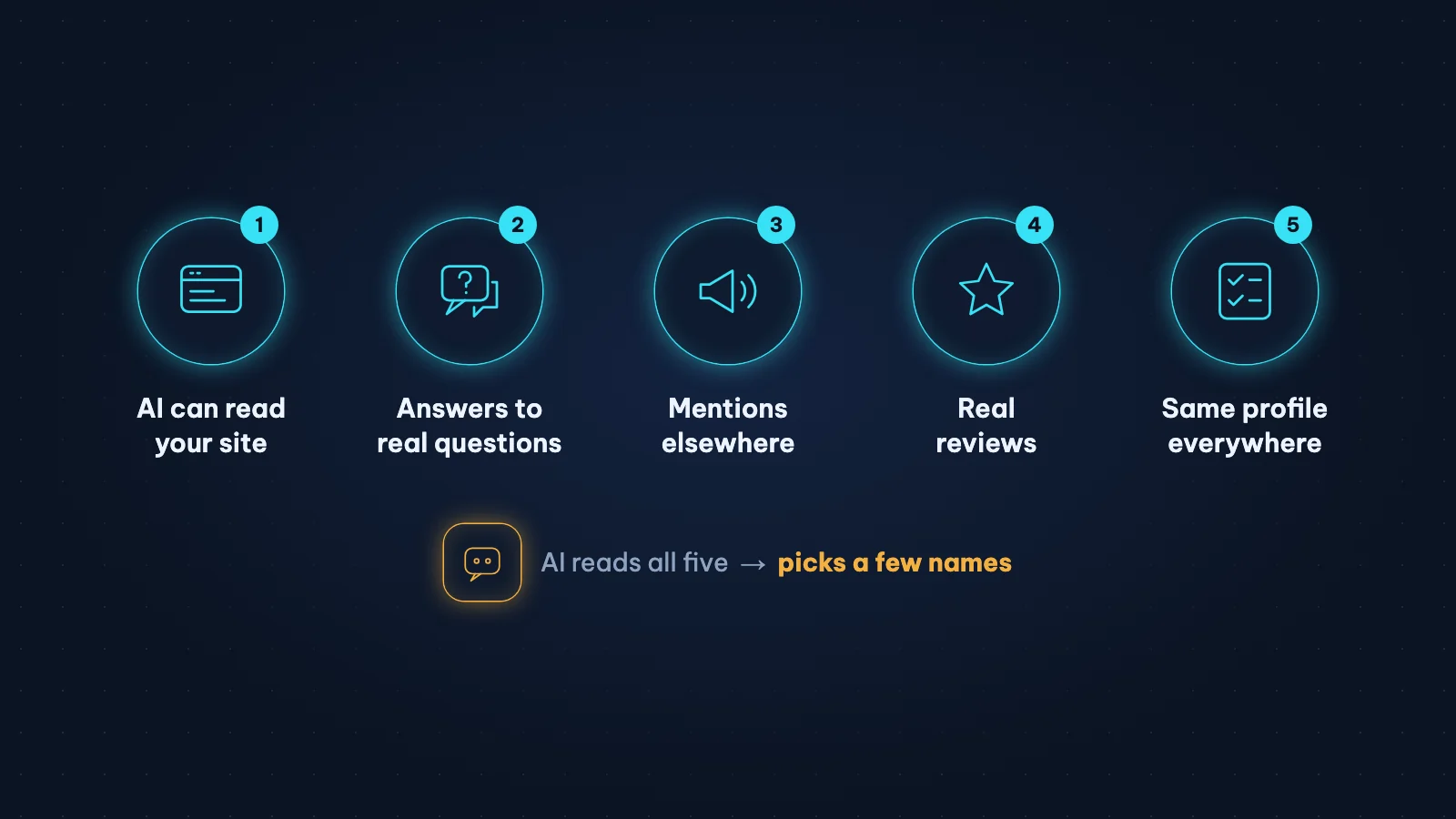
1. AI can read your website
AI can only mention what it can read. ChatGPT searches the web with a bot called OAI-SearchBot; according to OpenAI’s documentation, sites that block this bot in their robots.txt file are not shown in ChatGPT search answers. Google likewise only uses indexed pages as sources for its AI summaries. Check that your website does not accidentally block these bots, and put key information such as services, prices and address in text on the page, not only in images or design files. Google also advises keeping important content in text form.
2. Your website answers the questions customers ask
AI looks for passages that answer exactly what the customer asked. A service page that says clearly what you do, for whom, roughly what it costs and how long it takes, with a frequently asked questions (FAQ) section, is far more likely to be cited than a page with only a slogan. Keywords still matter, but in the sense of “using the words your customers use”, not stuffing terms. Add specific numbers and name your sources: the GEO (Generative Engine Optimization) study by researchers from Princeton University and IIT Delhi (KDD 2024) tested AI search engines and found that adding statistics, quotations and sources made content more visible in the answers, by about 40% in some cases.
3. Mentions elsewhere
An Ahrefs study (05/2025) of about 75,000 brands found that the factor most strongly linked to appearing in Google’s AI summaries is how often the brand is mentioned on other websites (correlation 0.664), stronger than the number of backlinks (0.218). A follow-up study (12/2025) extended this to ChatGPT and found that mentions on YouTube had the highest correlation (about 0.737). Ahrefs also notes that correlation is not causation, but the direction is clear: the more the press, YouTube, LinkedIn, forums and partners talk about you, the more grounds AI has to mention your name.
4. Real customer reviews
Reviews are evidence written by real customers, so both people and AI take them seriously. According to BrightLocal (2026), 97% of consumers read reviews before choosing a local business, and 82% read the AI-written review summaries. The number of reviews, how recent they are, how specific they are, and whether the business replies are all things AI can read and summarize for customers.
5. A complete profile that is the same everywhere
For questions like “near me”, “in Hanoi” or “in Binh Duong” (an industrial area in southern Vietnam), AI needs structured data: name, address, opening hours, business category, photos, phone number. The easiest source is your business profile on Google Maps (Google Business Profile); an empty profile, wrong hours or the wrong category is the fastest way to be skipped. This information must be the same on your website, Google Maps, Facebook, LinkedIn and directory sites. When each place lists it differently, AI cannot be sure it is the same business, and is more likely to answer wrongly or skip you.
How can you check whether your brand is mentioned by AI?
The fastest way is to ask AI the exact questions your customers would ask. It takes about 30 minutes and needs no paid tools:
| Step | What to do | What to record |
|---|---|---|
| 1 | List 10 questions real customers ask before buying, for example “which software company is reliable for a factory in Bac Ninh?” (an industrial area near Hanoi) | The list of questions, reused every month |
| 2 | Ask them one by one on ChatGPT, Gemini and Google (read the AI summary) | Whether your business is named, and in what position |
| 3 | Read carefully what AI writes about you and your competitors | Whether AI describes you correctly, what it praises and what it criticizes |
| 4 | See which sources AI cites | Which pages are “speaking for” your business: Google Maps, the press, forums, competitors |
The results usually fall into one of three cases: AI does not know you, AI knows you but describes you wrongly or incompletely, or AI names you correctly but ranks you behind competitors. Each case needs a different response, and this record is the starting point for measuring progress month by month.
What should a business do to get mentioned by AI?
There is no special technical trick to “game” AI. Google states clearly in its official guidance that appearing in AI Overviews and AI Mode requires no special optimization beyond the usual search requirements, and that unique, helpful content for readers is the factor with the most lasting impact. What you need to do, then, is make the information about your business complete, accurate and confirmed by others:
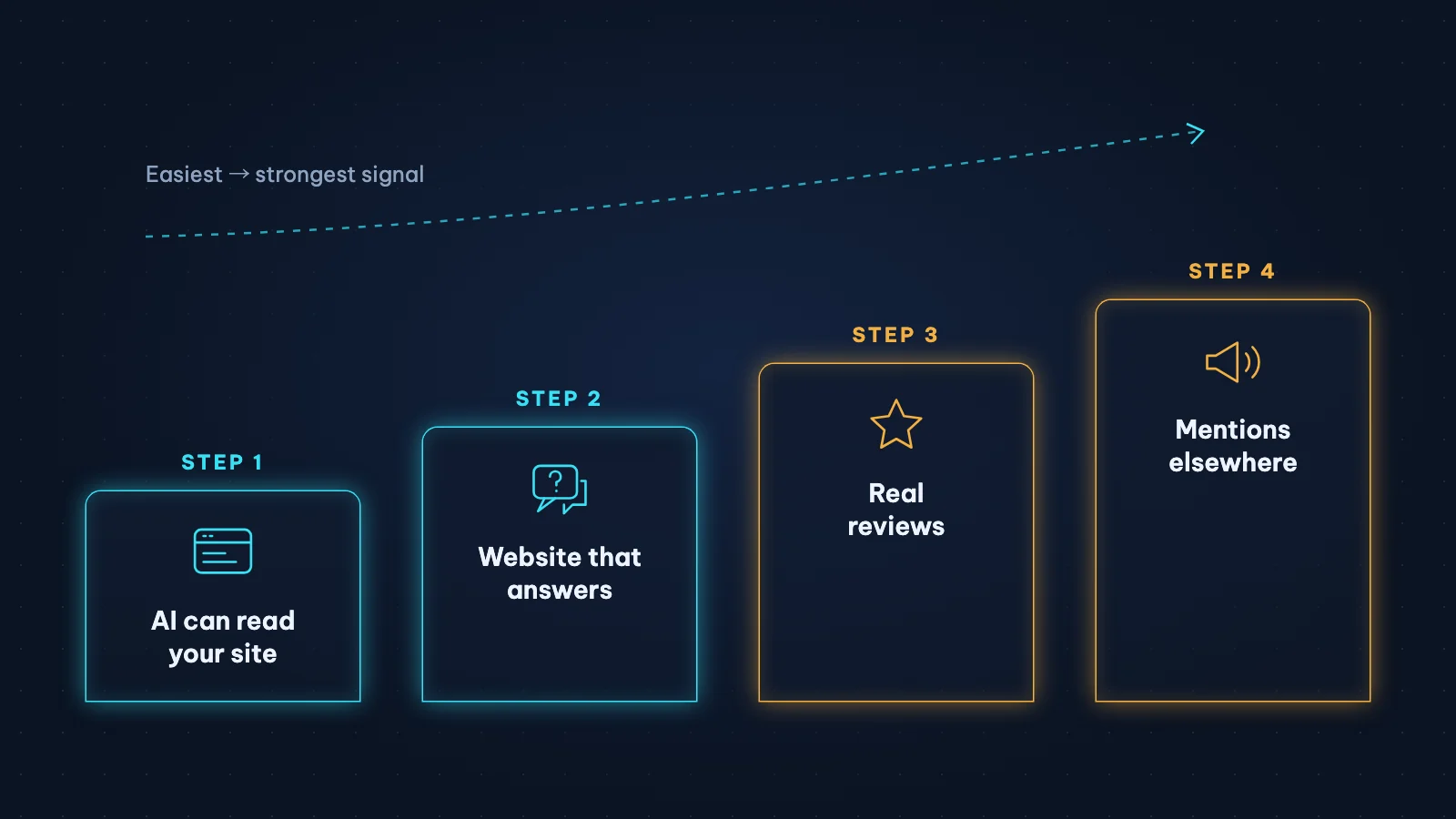
- Step 1: Let AI read your website. Check that your robots.txt file does not block ChatGPT’s OAI-SearchBot or Googlebot; write your services, prices and address as text on the page, not inside images.
- Step 2: Build a website that answers questions. One clear page per service: what you do, for whom, roughly what it costs and how long it takes. Add an FAQ section, specific numbers with sources, and articles that share real industry knowledge.
- Step 3: Get real reviews, steadily, and reply to each one. Ask for a review after every job done well; reply to negative reviews too, specifically. Do not buy fake reviews: it breaks Google’s policies, and both people and AI can easily spot them.
- Step 4: Get mentions elsewhere. Press articles, conferences, partners, industry communities, YouTube videos, LinkedIn posts. This takes the most time, but it is the strongest signal.
Alongside these four steps, complete your Google Maps profile and keep your name, address and phone number the same everywhere. You only need to do this once, then update it when something changes.
After that, repeat the self-check above every month to see how many questions your business name now appears in, and whether AI describes you more accurately. If you want to understand why doing AI systematically matters more than ad-hoc use, you can read our article what your competitors are doing with AI (in Vietnamese).
References
- Pew Research Center, Google users are less likely to click on links when an AI summary appears in the results (07/2025).
- Google, Q2 earnings call: CEO’s remarks (07/2025).
- TechCrunch, Sam Altman says ChatGPT has hit 800M weekly active users (10/2025) and ChatGPT reaches 900M weekly active users (02/2026).
- BrightLocal, Local Consumer Review Survey 2026 (02/2026).
- Ahrefs, An Analysis of AI Overview Brand Visibility Factors (75K Brands Studied) (05/2025).
- Google Search Central, AI features and your website.
- OpenAI, Overview of OpenAI Crawlers (OAI-SearchBot).
- Aggarwal et al., GEO: Generative Engine Optimization (KDD 2024).
If you are worried about your company’s marketing and brand now that customers ask AI before they find you, contact TMI. We can check together what AI is saying about your business and your competitors, then pick a few things to do first so you see results as early as possible. Learn more about how TMI’s AI FDE engineers work with businesses.
Frequently asked questions
What does it mean for a brand to be mentioned by AI?
It means that when customers ask ChatGPT or Gemini, or read Google’s AI summary, about a need in your industry, your business name appears in the answer with an accurate description. AI answers usually contain only three to five names, so a business that is not mentioned is barely considered by that customer.
How does AI decide which businesses to mention?
AI combines information from many sources. First it has to be able to read your website; then it draws on content that answers questions directly such as service pages and FAQs, news articles, forums and videos that mention the business, customer reviews and the Google Maps profile. An Ahrefs study (05/2025) of about 75,000 brands found that how often a brand is mentioned on other sites has the strongest correlation with appearing in Google’s AI summaries.
How can I check whether my business is mentioned by AI?
List about 10 questions real customers ask before buying, then ask them one by one on ChatGPT, Gemini and Google. Record whether AI names your business, whether the description is right or wrong, and which pages it cites. Repeat every month with the same set of questions to measure progress.
Do I need separate SEO for AI search?
According to Google’s official guidance, appearing in AI Overviews and AI Mode requires no special technical optimization beyond the usual search requirements. On the technical side, the main thing to check is that your site does not block Google’s and ChatGPT’s bots. What matters is that your business information is complete and consistent everywhere, your content answers customers’ questions, and real customers and other sources confirm it.
Do small businesses have a chance of being mentioned by AI?
Yes. For questions tied to a location or a narrow need, AI needs specific information such as address, services and reviews. A small business with a complete Google Maps profile, real reviews and a clear FAQ page can be mentioned ahead of larger companies whose information is thin.