Claude for Manufacturing is here: what do Vietnamese factories need to prepare to use AI for manufacturing?
TMI Soft team, AI FDE Engineer8 min read

Quick summary
To use AI for manufacturing in Vietnam, the thing that needs the most preparation is not the AI tool but the data. On 12 November 2026, Anthropic launched Claude for Manufacturing: 17 skills that draft quotes, investigate quality failures, diagnose machine downtime and always stop for the person in charge to approve. But the built-in connectors cover only 4 foreign software products, while many Vietnamese factories run on Excel, Zalo, MISA, Fast, Odoo and handwritten slips. Skills can be written in-house; the hard part is gathering data from each department, cleaning it and linking it so AI reads it correctly.
Key takeaways
- Claude for Manufacturing is a set of 17 skills (written instruction files) for Claude Team/Enterprise, and every output stops at a review step by the person in charge
- Built-in connectors cover only Autodesk Fusion, Infor, Microsoft 365 and Oracle NetSuite; software common in Vietnam has to be connected separately
- It can be connected: Odoo already has MCP so Claude can read its data, and skills can be written for each factory’s own process
- Data is the hardest part: each department keeps its own file, item codes do not match, and much information lives only on paper and in Zalo groups
- Start with one recurring problem (quoting, repeated defects or machine downtime), clean only the data it needs and measure results before expanding
On 12 November 2026, Anthropic launched Claude for Manufacturing, an AI toolkit built for factories. The news spread quickly through engineering and manufacturing groups in Vietnam, with one very practical question attached: our shop runs on Excel, Zalo and accounting software, so can we use it? This article answers that question and shows what a factory needs to prepare before putting AI into daily operations.
What is Claude for Manufacturing and what can it do for a factory?
Claude for Manufacturing is a plugin of 17 skills for Claude Team and Enterprise plans that drafts quotes, investigates quality failures, diagnoses machine downtime and writes production reports, with the person in charge approving the final step. It is not a new AI model. Each skill is a written instruction file describing the steps an experienced engineer would take (Anthropic, 11/2026).
Some of the tasks Anthropic describes:
- Quoting a new job: list missing information, refer to similar past jobs and draft a quote.
- A batch that fails inspection: open a case, search past defect reports, rank likely causes and draft a corrective action report.
- Machine downtime: read sensor data, repair notes, photos and manuals to suggest where the technician should check first.
- Finding an alternative supplier: draft a request for quotation (RFQ) and compare the bids received.
- Production reporting: output against target, downtime and cost.
Two points matter for managers. First, every skill ends with the person in charge reviewing and approving before a draft reaches a customer or supplier; an Anthropic representative told Manufacturing Dive the aim is "making sure a person is signing off on every draft" (Manufacturing Dive, 11/2026). Second, Claude does not operate machines; it handles the paperwork, lookups and analysis around them.
Anthropic also cites a 2025 survey by the Manufacturing Leadership Council: 79% of manufacturers still enter data by hand. In other words, even in industrialised countries the bottleneck is data.
Do the built-in connectors match the software Vietnamese factories use?
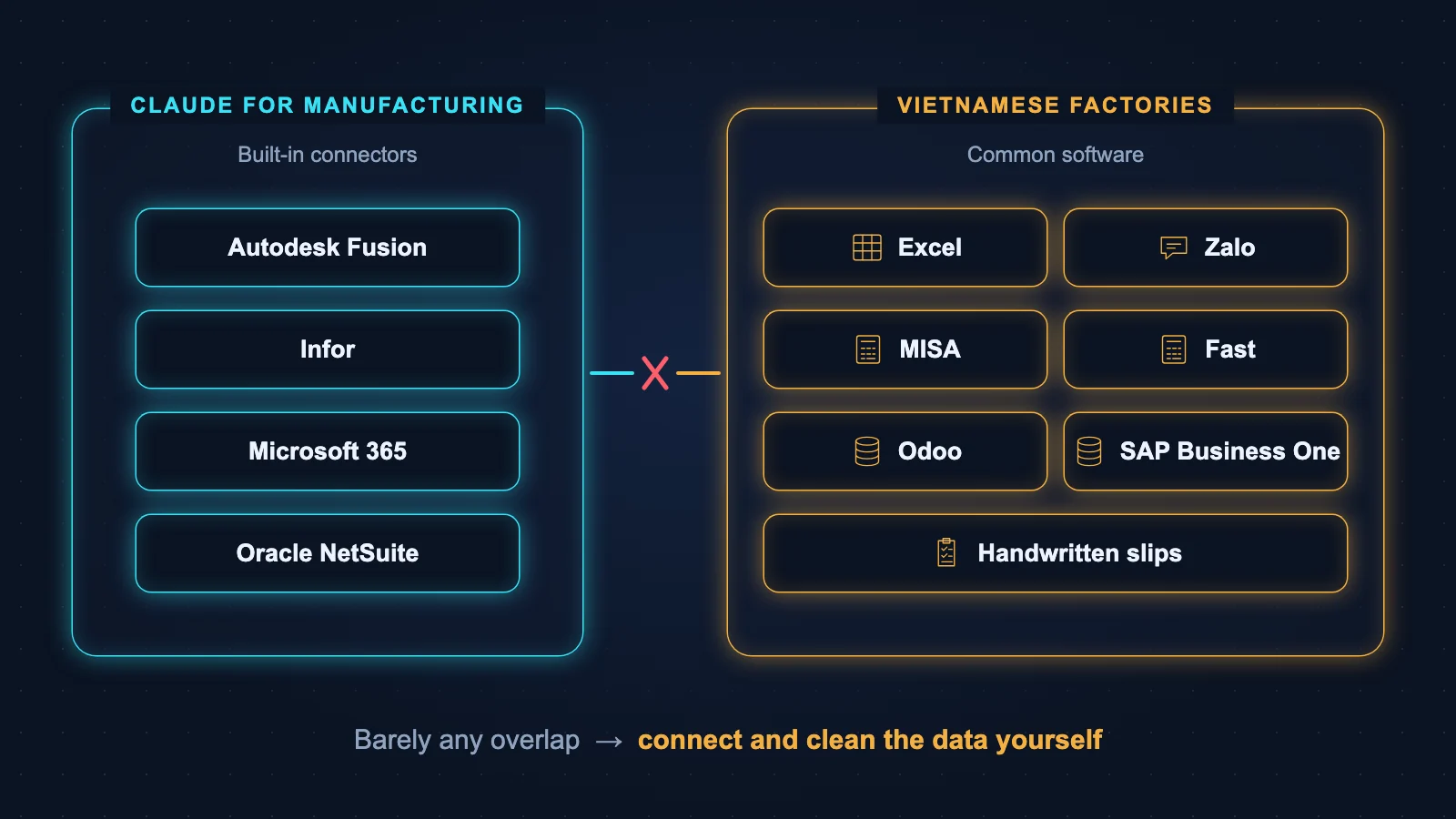
Hardly at all. Claude for Manufacturing comes with connectors for 4 products: Autodesk Fusion (design), Infor (ERP), Microsoft 365 and Oracle NetSuite (ERP). For systems without a connector, Anthropic suggests exporting files regularly into Microsoft 365 for Claude to read. The Infor connector is also read-only, for looking up purchase orders and inventory; for Claude to change data, companies need a separate plugin built by Infor that runs under each user’s permissions.
Meanwhile, this is the software commonly seen in Vietnamese factories (a field observation, not survey data):
- Small shops: plans, inventory and quotes live in Excel; tasks and defects are reported in Zalo groups. Zalo, Vietnam’s most widely used messaging app, has about 79 million monthly users (VNG via Tuoi Tre News, 12/2025), so many shop-floor decisions exist only in chat messages.
- Accounting: usually MISA, Fast or Bravo, the main local accounting packages. MISA alone reports serving hundreds of thousands of organisations (Nhan Dan, Vietnamese-language source).
- Larger plants: Odoo, SAP Business One or an ERP chosen by the parent company.
- On the line: handwritten inspection sheets, shift logs and maintenance logs are still very common.
There is no reliable data on what share of Vietnamese factories use ERP or Excel. But one related indicator exists: in the Agency for Enterprise Development’s digital transformation assessment, the pillar "IT systems and data management" scored lowest, at just 3.8 points in 2024 (State Management Review, 06/2026, Vietnamese-language source).
Without a built-in connector, can a factory still use AI?
Yes, because a skill is only a written instruction file, and there is now a standard way to connect Claude to other software. Two examples from November 2026:
- Odoo: Odoo has an official MCP (Model Context Protocol, an open standard for connecting AI to software) module that lets Claude read data under the logged-in user’s permissions (Odoo Apps). The Deploy Systems channel connected Claude for Manufacturing to Odoo 20 and ran 5 scenarios in a demo machine shop: a morning production report, downtime diagnosis, a failed batch, a quote from a drawing and sourcing a new supplier (Deploy Systems, 11/2026).
- Home-made skills: The IT/OT Insider ran Anthropic’s root cause analysis skill on simulated data from a hydropower plant, then compared it with a simple skill they wrote themselves on the same data. Their conclusion: the hardest part is not the skill but getting the data, aligning it and giving it context (The IT/OT Insider, 11/2026).
For Vietnamese factories, this means there is no need to wait for MISA or Fast to get an official connector. A skill written for the factory’s own process, reading cleaned data, can do most of what Anthropic’s 17 skills do. The software needed around AI is covered in more detail in Beyond the AI Itself: What Software Does a Company Need to Make AI Really Work?
Why is data the hardest part of AI for manufacturing?
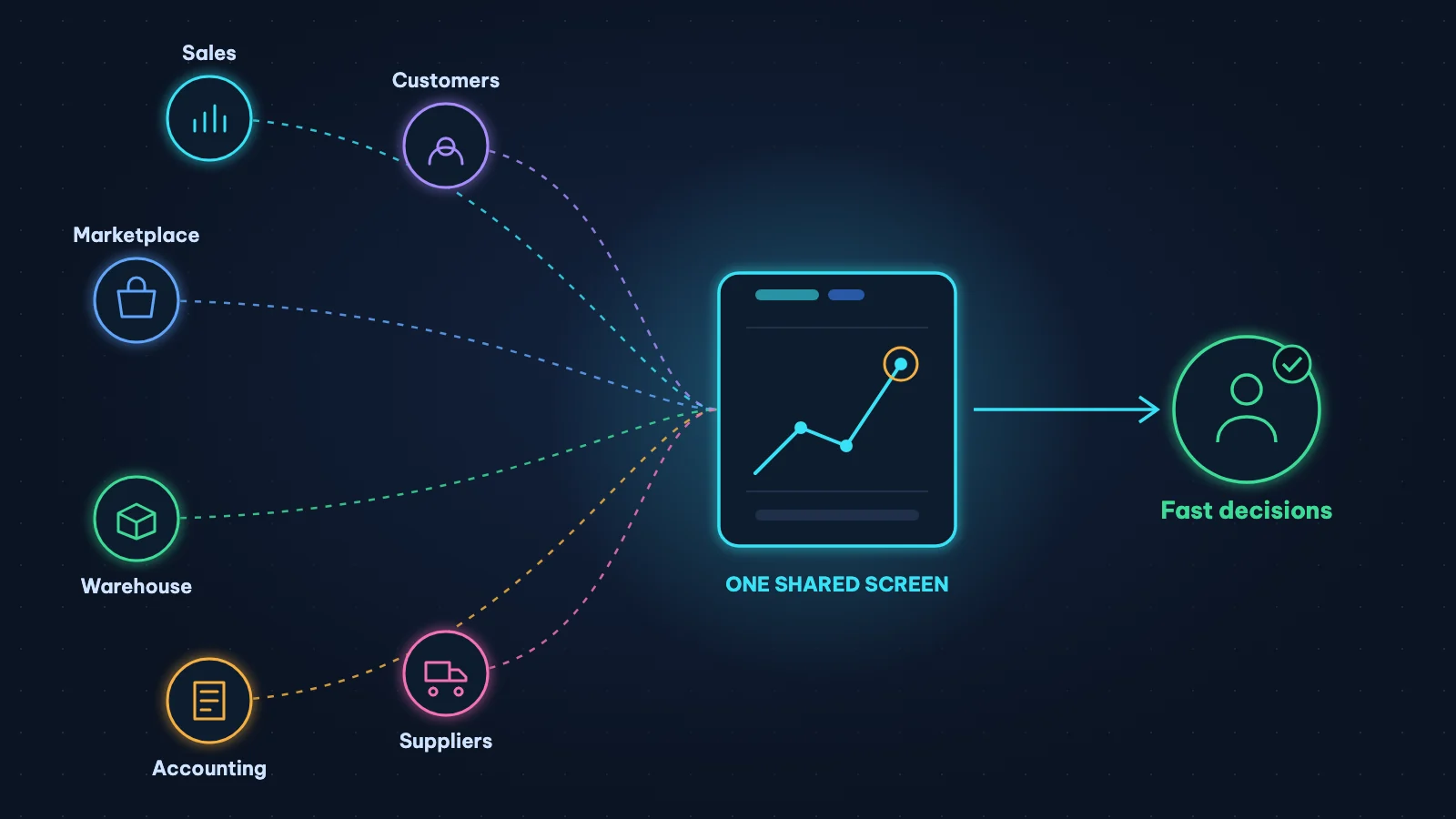
Because AI only answers correctly when it reads the right data, and factory data is usually scattered across departments, recorded in different ways and not linked together. A simple question like "why was last week’s batch returned" needs data from at least four places: the order in sales, inspection sheets in quality, the machine maintenance log and the material lot in the warehouse. Common problems:
- Each department has its own file: sales, warehouse and accounting name the same item differently.
- Data on paper: inspection sheets and shift logs were never entered into a computer.
- Knowledge in messages and in people’s heads: "machine 3 jams whenever it is humid" exists only in a Zalo group or in the team leader’s head.
- Nobody owns the cleanup: software is bought, but without someone inside the company driving it, data drifts back to Excel.
That last point has clear numbers. The World Bank followed 605 Vietnamese SMEs supported to adopt cloud ERP: about 80% used it right after training, but after about 18 months only about 35% still did. The main reasons were being busy, having no one inside the company to drive it, or that person leaving (World Bank, 05/2025). PwC Vietnam also names fragmented databases that cannot provide clean data as one of the major gaps holding Vietnamese firms back from scaling AI (VIR, 06/2026).
In other words, AI use in Vietnamese companies is growing fast but is still mostly at the trial stage. According to an AWS survey in 2026, 26% of Vietnamese businesses use AI, but only 8% have fully built it into their workflows (VnEconomy, 09/2026, Vietnamese-language source). Much of the gap between those two numbers is data. A similar lesson from Palantir’s Maven system is analysed in data consolidation and faster decisions with AI.
What steps should a factory follow to use AI for manufacturing?
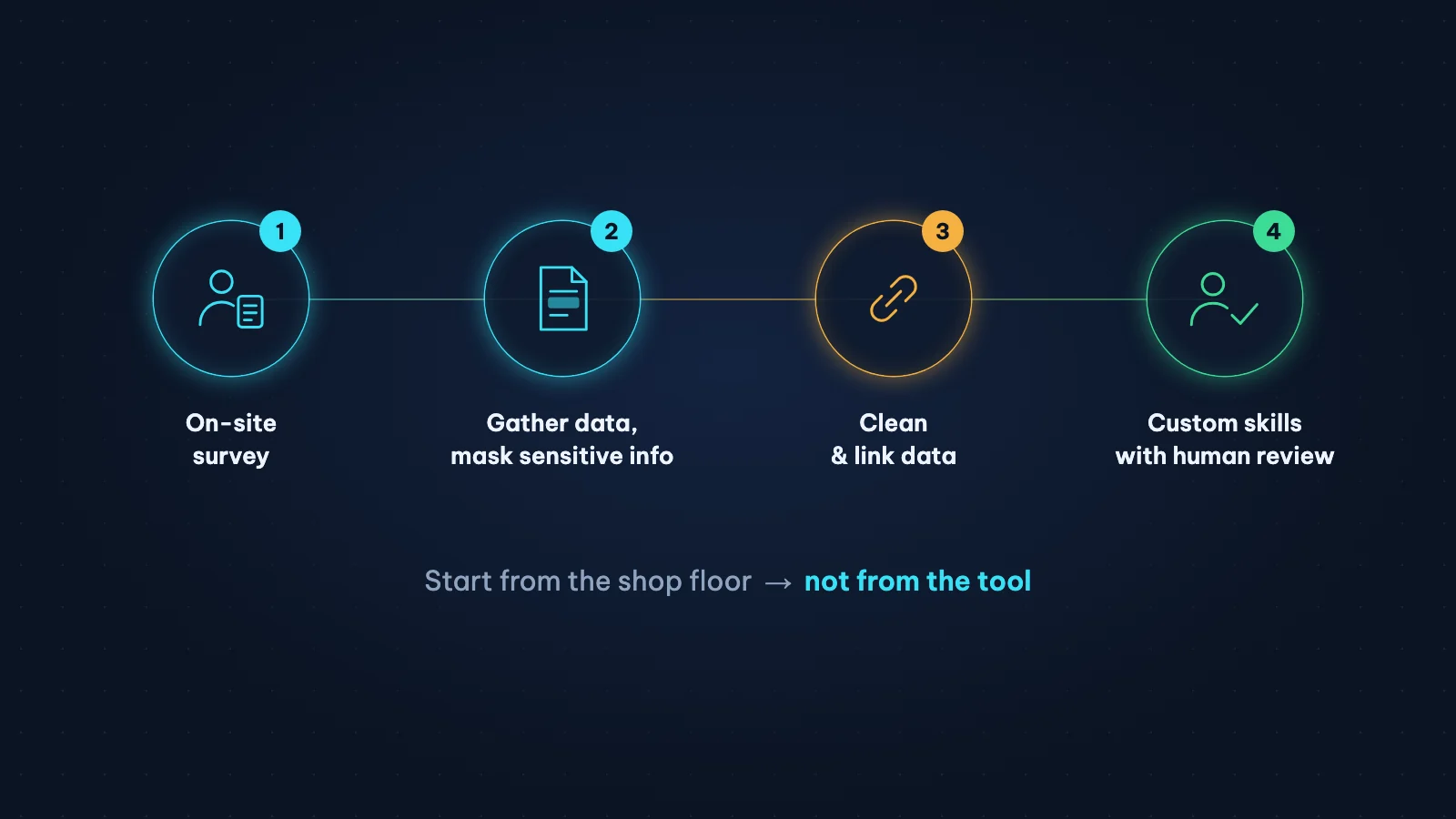
Follow four steps: an on-site survey, gathering data and masking sensitive information, cleaning and linking the data, then writing custom skills with human review. This is also how TMI Soft’s AI FDE (Forward Deployed Engineer, an engineer who works directly with the client’s team) engineers work with clients.
1. On-site survey
Engineers go to the factory and sit with the people who prepare quotes, line leaders, quality and maintenance staff to ask how the work really happens: who does it, how long it takes, which files they open, whom they ask, where mistakes happen. Most of the important information is not in process documents but in how people work every day.
2. Gather data and mask sensitive information
Gather only the data the problem needs: Excel files, exports from MISA or Odoo, photos of handwritten slips, related message history. Personal information, customer names and sensitive prices are masked or encoded before going to AI. Vietnam’s Personal Data Protection Law No. 91/2025/QH15, in force since 1 January 2026, requires personal data in AI systems to be processed only for the stated purpose and within the necessary scope (LuatVietnam, 08/2025, Vietnamese-language source).
3. Clean and link the data
Align item codes, machine codes and defect names across departments; enter the paper data that is needed; link orders to production lots, inspection sheets and maintenance logs. This is the most laborious step and the one that decides whether AI answers right or wrong. Where needed, connect directly to the software in use (for example Odoo via MCP) so data updates itself instead of being exported every week.
4. Custom skills, human review and measured results
Write skills in the factory’s own process and terminology, test them on real data, and have the person in charge approve every output before it goes out. Measure before and after: time to prepare a quote, days to find a defect’s cause, machine downtime. Only expand to a second problem once the first one runs smoothly.
Which problem should a factory start with?
Start with a recurring task that takes many hours of experienced people’s time and already has data, even if the data is messy. The three problems below are also the three that Claude for Manufacturing targets:
| Problem | Data needed | Who approves the output |
|---|---|---|
| Slow quoting | Past quotes, drawings, bills of materials, latest purchase prices, machining times | Head of sales |
| Repeated quality defects | Inspection sheets, past defect reports, material lots, machines and shifts | Head of quality |
| Frequent machine stops | Maintenance logs, downtime history, repair notes, manuals, sensor data if available | Head of maintenance |
Pick the problem causing the biggest loss that has someone ready to approve the results. How to choose the first problem is covered in Where Should a Business Start with AI?
References
- Anthropic, Introducing Claude for Manufacturing (11/2026).
- Manufacturing Dive, Anthropic launches Claude for Manufacturing (11/2026).
- Deploy Systems, Odoo 20 MCP + Claude for Manufacturing: Setup and 5 Real Scenarios (YouTube, 11/2026).
- The IT/OT Insider, I tested Claude for Manufacturing: Bombshell or Just Another Tool? (YouTube, 11/2026).
- Odoo Apps, Odoo Remote MCP.
- World Bank, Challenges with digital technology adoption by SMEs: a case study (05/2025).
- VIR, Data and governance key hurdles to AI scaling for Vietnamese firms (06/2026).
- VnEconomy, Gần 245.000 doanh nghiệp Việt Nam đang ứng dụng AI (09/2026) (Vietnamese-language source).
- State Management Review, Chuyển đổi số tại doanh nghiệp nhỏ và vừa ở Việt Nam (06/2026) (Vietnamese-language source).
- Tuoi Tre News, Vietnam's 80-million-user messaging giant Zalo (12/2025).
- Nhan Dan, MISA – Thương hiệu quốc gia (Vietnamese-language source).
- LuatVietnam, Doanh nghiệp trí tuệ nhân tạo chỉ được xử lý dữ liệu cá nhân trong phạm vi cần thiết (08/2025) (Vietnamese-language source).
If your factory struggles with slow quotes, repeated defects or frequent machine stops and you want to know whether your current data is ready for AI, TMI’s AI FDE engineers can come on site, review the real process and data with your team, and propose which problem to tackle first.
Frequently asked questions
What is Claude for Manufacturing?
Claude for Manufacturing is a plugin Anthropic launched on 12 November 2026 for Claude Team and Enterprise plans, with 17 skills for factory work such as drafting quotes, investigating failed inspections, diagnosing machine downtime, finding alternative suppliers and production reporting. It is not a new AI model; each skill is a written instruction file. Claude does not operate equipment, and every output stops for the person in charge to review.
Can a factory that runs on Excel, MISA or Odoo use Claude for Manufacturing?
Yes, but it has to be connected separately, because the built-in connectors cover only Autodesk Fusion, Infor, Microsoft 365 and Oracle NetSuite. Odoo already has MCP so Claude can read data under each user’s permissions; Excel files and exports from accounting software can be shared through a common folder. The most effort goes into cleaning and aligning data across departments.
Which problem should a factory start with when applying AI?
Start with a recurring task that takes many hours and already has data, such as quoting, investigating repeated quality defects or diagnosing frequent machine stops. Pick one problem, clean only the data it needs, run a pilot with human review and measure the time saved before expanding.
Is it safe to give factory data to AI?
It is safer when the company shares only the data the problem needs, masks personal and sensitive customer information first, and uses a business AI plan with access control. Vietnam’s Personal Data Protection Law No. 91/2025/QH15, in force since 1 January 2026, requires personal data in AI systems to be processed only for the stated purpose and within the necessary scope.