Where Should a Business Start with AI? A 4-Step Roadmap from Problem to Real Operations
TMI Soft team, AI FDE Engineer5 min read

Quick summary
A business should start applying AI from a specific business problem with data and clear KPIs, not from a tool. An effective roadmap has 4 steps: diagnose to pick the 1–2 most valuable problems, validate on real data in a small scope, improve continuously with users, then move into formal operation and hand over so the internal team can run it themselves.
Key takeaways
- Start from a business problem and KPIs, not from an AI tool
- Choose 1–2 problems that are both high in value and feasible with the data you already have
- Validate on real data in a small scope before scaling
- AI creates value only when it sits inside daily workflows and the internal team can run it
Many companies in Vietnam have already tried AI: they use a chatbot, run a pilot model, watch a few impressive demos. But most stop there. The model works well on sample data and is never brought into daily work.
This article is for business leaders who want to apply AI in a practical way: where to start, which steps to follow, and what to avoid so that AI actually runs in operations instead of staying on slides.
Why do so many AI projects stop at the demo?

From our experience working with companies, TMI sees four causes repeat most often:
- The PoC is finished and then shelved. The model works on sample data but is not connected to the real process, so nobody uses it.
- The vendor delivers and leaves. The system is handed over once, and nobody internally knows enough to adjust it when the business changes.
- Lack of specialists. Hiring AI engineers and data scientists is both hard and expensive, especially for companies without an AI team of their own.
- A gap between IT and the front line. The people who understand the data do not understand the business, and the people who understand the business cannot code.
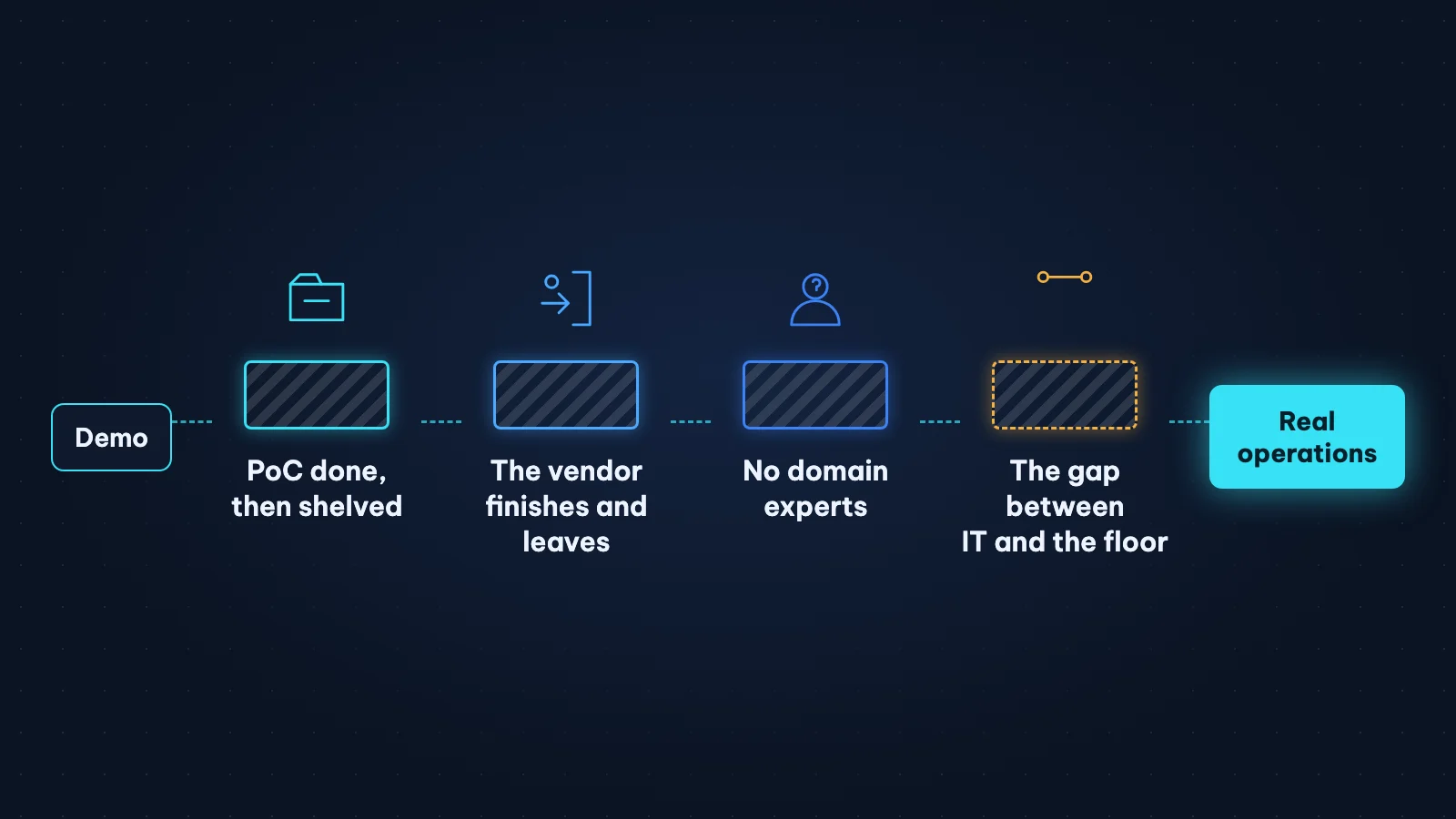
What all four share: the problem is not the AI technology but how it is deployed. So the right question is not “which AI tool should we use?” but “which business problem is worth solving with AI, and how do we make the solution survive in operations?”
Start from the problem, not the tool
A good problem to start with usually has three characteristics:
- It is tied to a repetitive, time-consuming task in operations: processing documents, screening applications, compiling reports, answering repeated questions from customers or staff.
- Data already exists or is easy to collect: records, emails, drawings, sales history, internal documents.
- The result can be measured: processing time, error count, response rate, cost per task. Without a KPI, you cannot tell whether AI really helps.
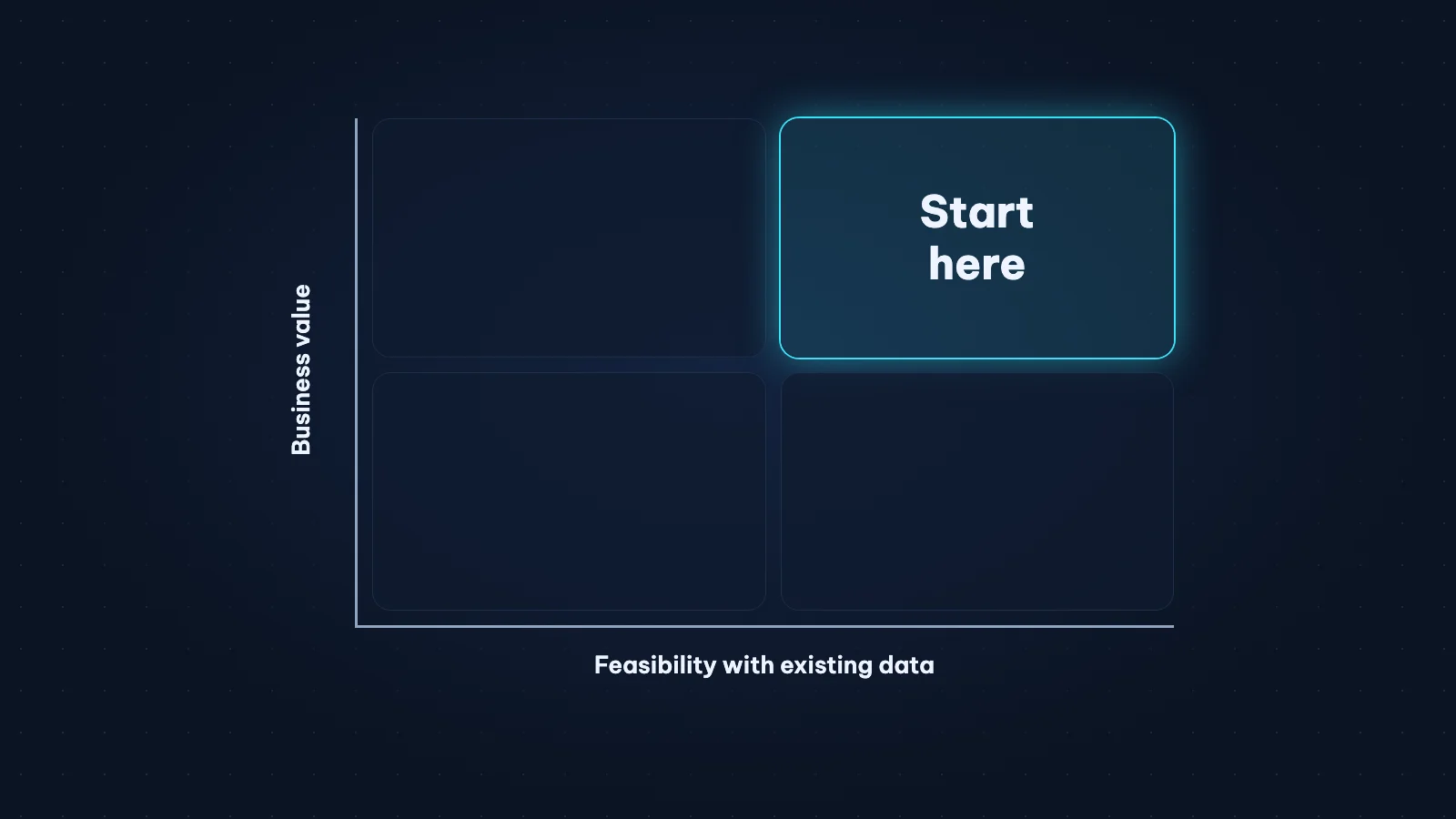
Some common problem types by industry:
| Field | Common problems |
|---|---|
| Manufacturing / Consumer goods | Demand forecasting, inventory optimization, visual quality inspection |
| Construction / Design | Generating renderings, images and video from drawings; looking up technical standards |
| HR / Recruitment | Screening applications, preliminary AI interviews, an internal policy assistant |
| Retail / Distribution | Sales analysis, order suggestions, automated customer care |
| Finance / Back office | Document processing, reconciliation, automated report compilation |
A 4-step roadmap to bring AI into real operations
This is the roadmap TMI applies when delivering AI under the AI FDE model. The timings below are a reference frame; in practice they depend on each company’s problem and data.
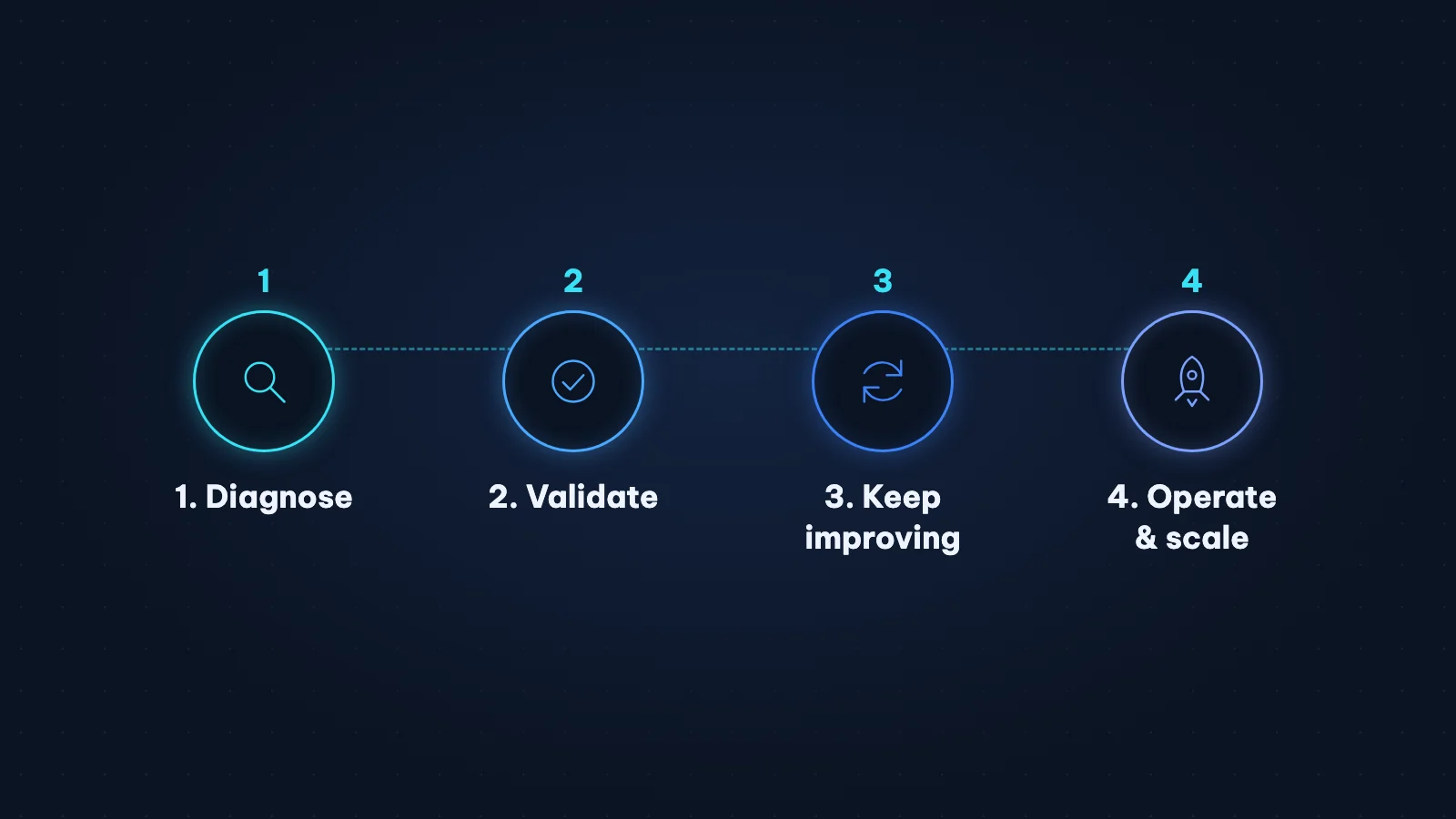
Step 1. Diagnose (about 3–4 weeks)
Clarify the business process, data and KPIs. From the list of ideas, choose 1–2 problems that are both high in value and the most feasible with the data you have.
Output: a diagnostic report, the priority problem and KPIs agreed by all parties.
Step 2. Validate (about 4–8 weeks)
Build and test on real data in a small scope, for example one department or one product line, to validate quickly before investing heavily.
Output: a solution that runs on real data, with results measured against the KPIs.
Step 3. Improve continuously (about 4–8 weeks)
Engineers work with users and improve in weekly loops. In parallel, internal staff receive hands-on training so they can adjust logic, prompts and processes themselves, including people who cannot code.
Output: a solution that meets the KPIs, with internal staff starting to improve it on their own.
Step 4. Operate and scale (about 2–4 weeks, then ongoing)
Put the solution into formal operation, then extend it to other departments. Hand over fully so the internal team can keep improving it; the partner only supports through a maintenance package or consulting when needed.
Output: AI capability becomes the company’s own capability, independent of the supplier.
AI FDE: why engineers should work alongside your team
FDE (Forward Deployed Engineering) is a model in which engineers do not wait for requirements in an office. They go directly into the customer’s work environment, work with real users, and build, test and fix in short loops until the solution works in the business process.

| Criterion | Traditional outsourcing | Strategy consulting | AI FDE |
|---|---|---|---|
| Where the work happens | At the vendor’s office | Periodic meetings with the client | Together with the client’s team |
| Output | Software to spec | Reports, roadmap | An AI solution running in the real process |
| Way of working | Waterfall, fixed spec | Analysis, recommendations | Short loops, continuous improvement |
| After the engagement | Dependent on the vendor | The client implements on their own | The internal team operates and improves it |
This model directly addresses two of the failure causes at the start of the article: the gap between IT and the front line, and “the vendor delivers and leaves”.
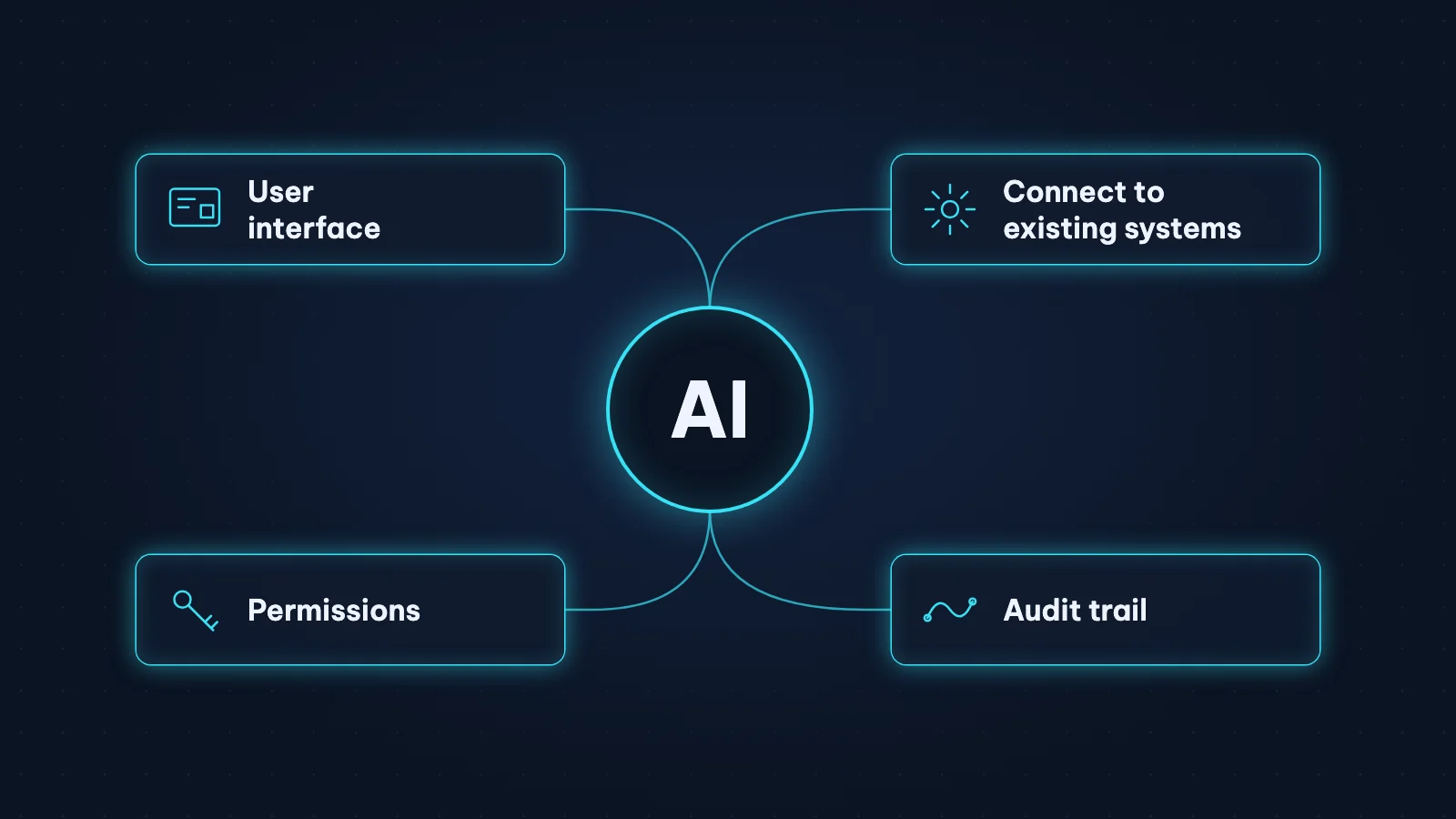
AI usually needs software around it
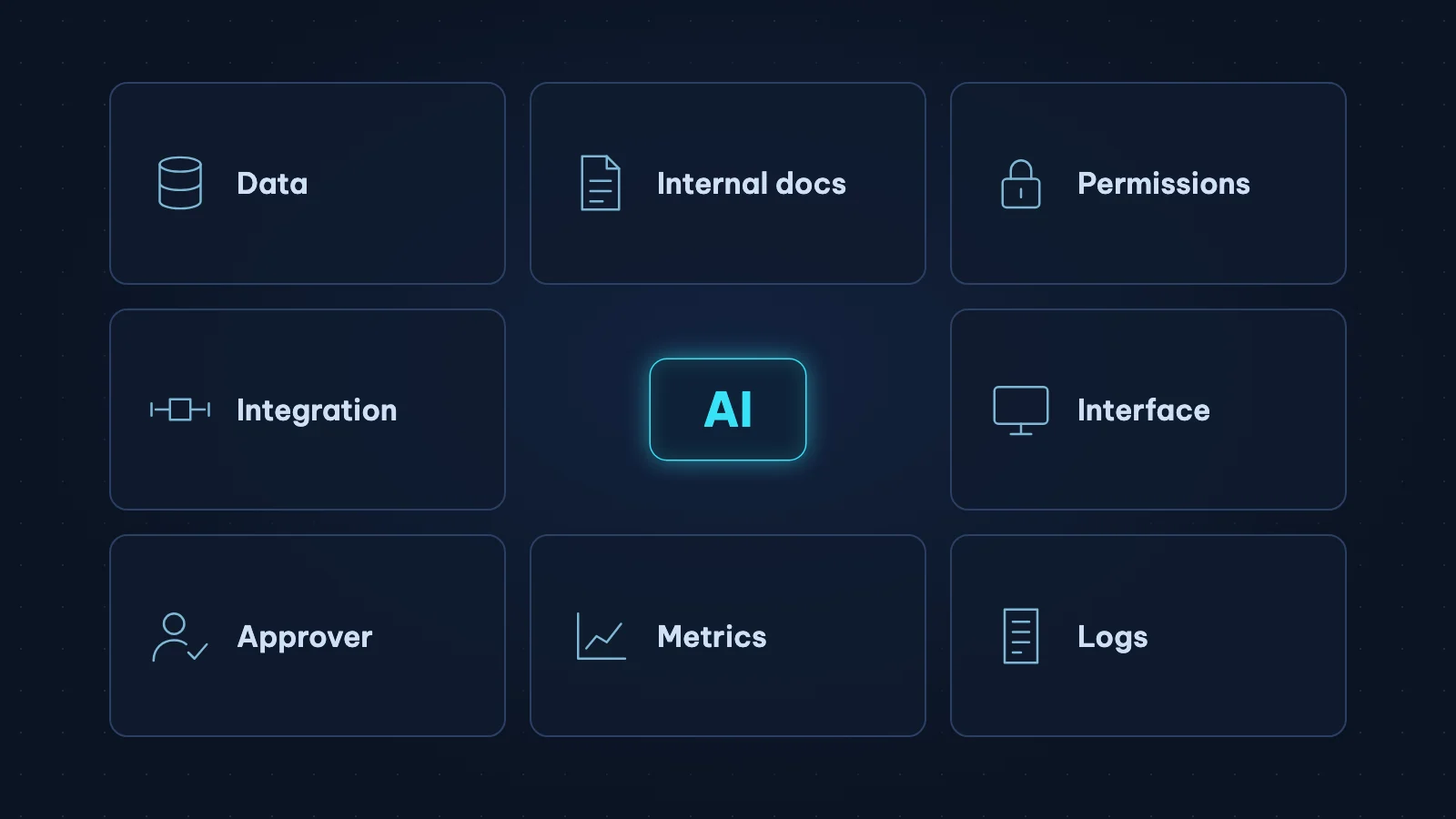
In practice, AI rarely stands alone. To run in operations, a company usually also needs user screens, connections to existing systems, permissions and audit trails. Examples from published TMI projects:
- VINATA: an AI system for the design team that automatically generates rendering images and video from 2D drawings, and supports changes to materials, furniture and design style.
- Jobhouse: software covering the entire staffing-agency workflow for digital transformation, which TMI continues to operate and maintain monthly.
So when choosing a partner, prefer one that can both advise on the AI problem and build the surrounding software and operate it over the long term.
Checklist before you start

- You have 1–2 specific business problems, each with an owner on the company side.
- You know where the data is and who has access to it.
- KPIs for measuring results are agreed.
- Infrastructure and data security requirements are defined (which infrastructure it runs on, which AI model is used).
- There is a training plan so the internal team can operate it after deployment.
If your company is at the stage of finding its first problem, a short conversation with a TMI engineer can help identify a suitable starting point.
Frequently asked questions
Should a small business apply AI?
Yes, if it starts from a specific problem that has data and measurable results. A small validation scope (one department or one product line) lets a company experiment at low cost and risk before scaling.
How long does it take to deploy AI in a company?
Under TMI’s 4-step roadmap, diagnosis takes about 3–4 weeks, validation 4–8 weeks, continuous improvement 4–8 weeks, then operation and scaling 2–4 weeks and onward on an ongoing basis. Actual timing depends on the problem and the data.
Can we deploy AI without an in-house AI team?
Yes. With the AI FDE model, AI engineers work alongside the company’s team and provide hands-on training so internal staff, including people who cannot code, can adjust and operate the solution themselves.
How does AI FDE differ from outsourced software development?
Outsourcing usually delivers software to a fixed spec and then ends. AI FDE works with users in short loops until the solution meets the KPIs in the real process, then hands over so the internal team can run it.
Is company data safe when using AI?
The solution can be deployed on infrastructure designated by the company, and the AI model is chosen according to the company’s data policy. Security requirements should be agreed right from the diagnosis step.