Outsourced Dev, BrSE, IT Consulting or FDE? A Comparison to Pick the Right Partner for Applying AI
TMI Soft team, AI FDE Engineer6 min read

Quick summary
Each role holds one part of a project and starts from a different point: outsourced development starts from a finalized spec, BrSE from finalized requirements, IT consulting from organizing the problem, and IT sales from the product to sell. The FDE (Forward Deployed Engineer) holds all four stages: requirements discovery, analysis & proposal, development, and deployment & operation, and starts from the company’s purpose and business goals. If the problem is still vague and nobody internally holds the whole chain, the FDE is the lowest-risk choice.
Key takeaways
- When AI makes writing code cheaper, the hard part is building the right thing and getting it into real operations
- A working AI project must pass 4 stages: requirements discovery, analysis & proposal, development, deployment & operation
- Outsourced development, BrSE, IT consulting and IT sales each hold only one part of the chain; an empty stage by default belongs to the company
- The FDE holds all 4 stages and starts from the company’s business goals, so it can also propose non-software solutions
- When choosing a partner, ask: who meets real users, how soon is there a draft, how is success measured, and who stays after go-live
Many companies have been through this: the system is delivered on time, to spec, and fully accepted. Half a year later, staff are still working in Excel as before, and almost nobody opens the system.
The fault is usually not in the code. It is that, across the whole project, nobody was fully responsible from asking the right question to the solution actually being used. So when a company starts applying AI, the question “who should we work with” matters just as much as “which technology should we use”.
This article compares five familiar options: outsourced development (a software company working on contract), BrSE (Bridge SE), IT consulting, the IT sales rep of a solution vendor, and the FDE (Forward Deployed Engineer), so you can choose the right person for the right problem.
When AI can write code, where does the hard part move?
AI is making design, programming and testing much faster and cheaper. When “making” becomes cheap, the value lies in building the right thing the company needs and getting it into real operations.
What a company needs is usually not yet put into words. Ask a manager “what problem are you facing?”, and a common answer is “I can’t think of a problem right off the bat”. AI handles what is already in documents and data very well. But asking so that the real need surfaces, deciding what to do, sitting with users until they are willing to change how they work, and taking responsibility for the result are still human jobs.
The four stages of an AI project that actually runs
Whatever its size, a project that reaches a result goes through four stages:
- Requirements discovery: interviewing and observing on site to understand the real problem and the company’s real goals, including requirements nobody has written down.
- Analysis & proposal: analyzing the business, proposing the solutions worth building, and also the things that do not need to be built.
- Development: design, programming, testing.
- Deployment & operation: putting it into real use, training and supporting users, monitoring operation, and taking responsibility for the result.
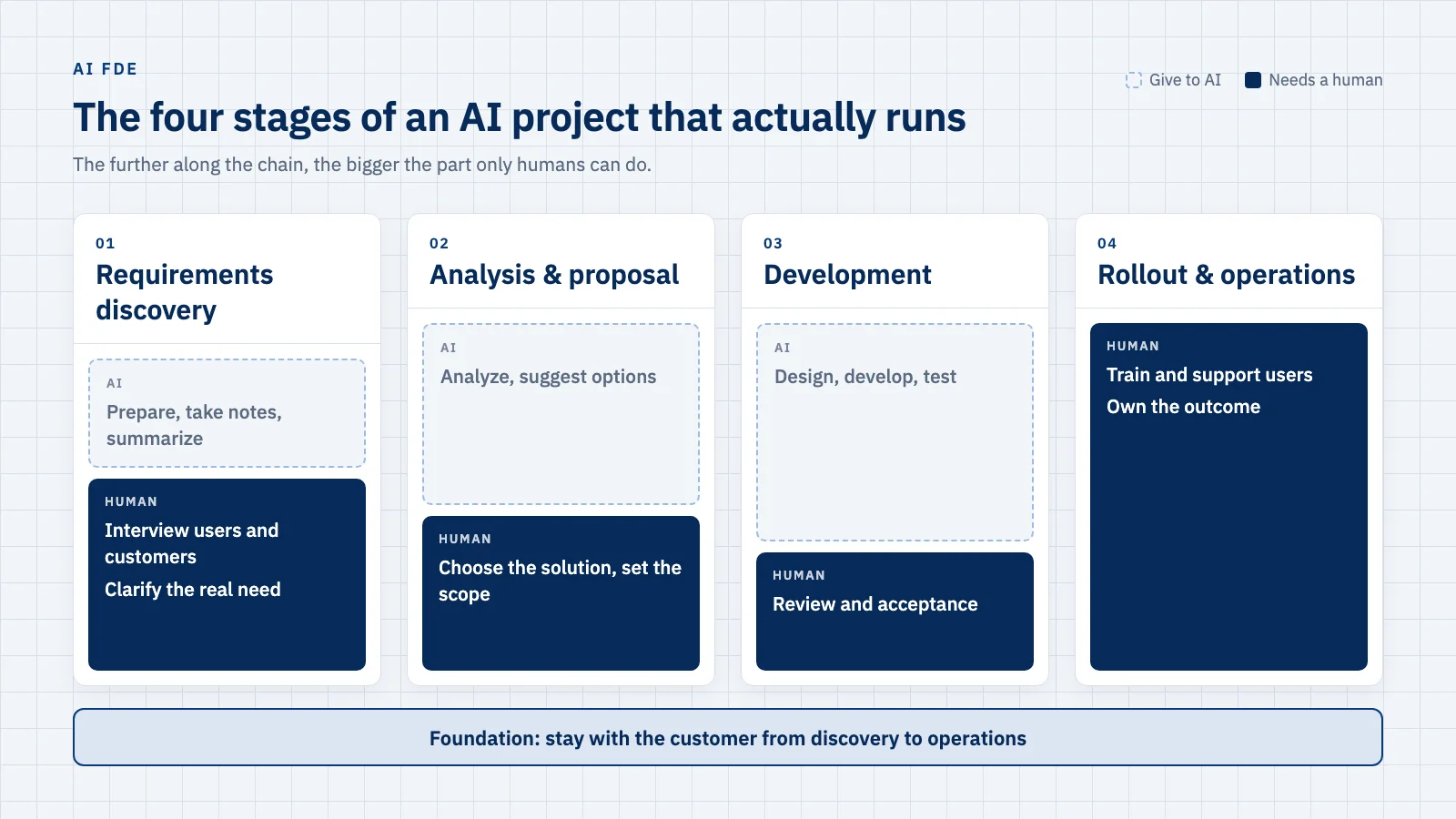
In the first three stages, AI can carry a significant part: preparing and summarizing sessions, analyzing and suggesting options, writing and testing code. But the later the stage, the larger the part that needs people. The deployment & operation stage is almost entirely human work, and it is also the stage most often left empty.
Comparing 5 options across the four project stages
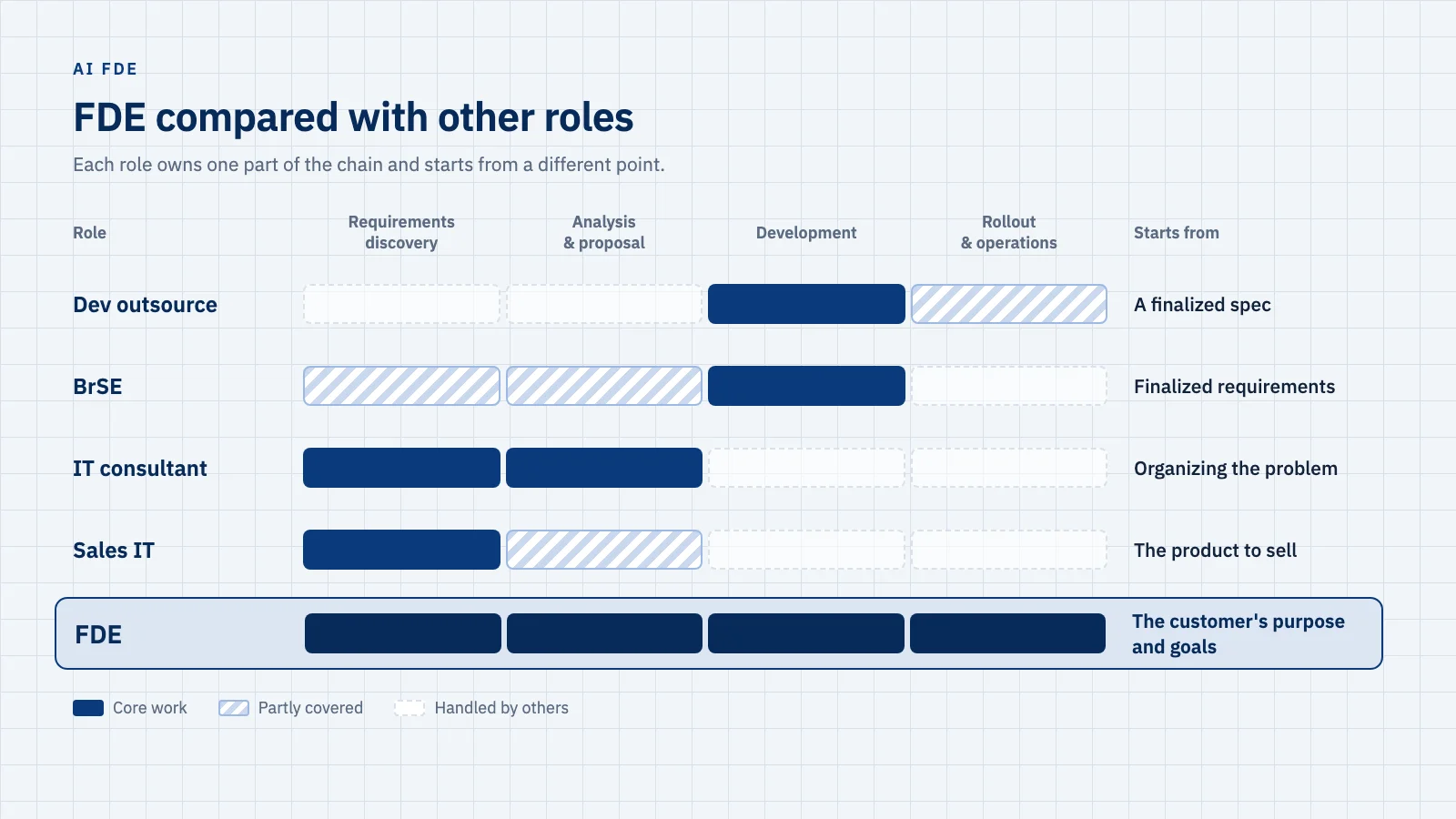
| Role | Requirements discovery | Analysis & proposal | Development | Deployment & operation | Starts from |
|---|---|---|---|---|---|
| Outsourced development | — | — | Core | Partial | A finalized spec |
| BrSE (Bridge SE) | Partial | Partial | Core | — | Finalized requirements |
| IT consulting | Core | Core | — | — | Organizing the problem |
| IT sales | Core | Partial | — | — | The product to sell |
| FDE | Core | Core | Core | Core | The company’s purpose and goals |
“—” means someone else handles that stage, usually the company itself.
Outsourced development
The strength is developing correctly and solidly to a specification. The company receives software exactly as described. In exchange, understanding the problem and writing the spec sit on the company’s side. If the spec drifts from the real need, the product can still be finished on time and not be used by anyone.
Suitable when: the company already knows exactly what it needs and has someone internally who can write the spec.
BrSE (Bridge SE)
A BrSE bridges the company and the development team, which is often overseas. They clarify the requirements the company provides and pass them on to the development team. The focus is still development; deployment and operation after go-live are usually out of scope.
Suitable when: the company has an internal IT team that knows the business and needs additional development capacity.
IT consulting
IT consultants are good at listening, organizing the problem and setting a direction. The result is usually a report or a roadmap. The development and deployment needed to turn the roadmap into a system used every day must be given to someone else, and every handoff drops some information.
Suitable when: the company needs strategic direction and already has its own delivery team.
IT sales
The IT sales rep of a solution vendor meets the company early and listens to the needs closely. But they always have a product to sell in front of them, so the solution is easily pulled toward the existing product rather than toward what the company needs.
Suitable when: the company has already determined which kind of tool to buy and is comparing vendors.
FDE (Forward Deployed Engineer)
The FDE covers all four stages: surveys the requirements, analyzes and proposes, develops using AI and other tools, then stays to deploy and operate until the solution is truly used in the work. The most important difference is the FDE’s starting point: not a spec, requirements or a product, but the company’s purpose and goals. That is why an FDE can propose a non-software solution (changing how work is done, reassigning roles), and can say plainly “this part does not need to be built”. For the definition and origin of this role, see What is an FDE?
Suitable when: the problem is still vague, the company has nobody internally who holds the whole chain from business to technology, and it needs measurable results instead of a demo.
The hidden cost lies in the gaps between parties
Each option above has its place. The real risk lies in the “—” cells: stages no partner handles, which by default belong to the company. The person who surveys is not the person who develops; the person who develops does not meet the users; the person who hands over does not stay when the system is left unused.
A common example: a system with many functions is introduced, but staff can only use a few parts, so features are cut. After the cut, even the accounting information that was actually needed is gone. Nobody was technically wrong, but nobody asked at the start: who will use it every day, who decides, and where will they get stuck once they use it.

5 questions to ask when choosing an AI partner
- Who will meet real users every day? If the answer is only “the project owner on the company side”, the requirements discovery stage is being left open.
- How soon will we see the first draft? Fixing something you have been shown is much easier than describing it from zero. With AI, a draft can be ready in days instead of months.
- Does the partner dare to say “this doesn’t need to be built”? Someone who can only sell when you buy more will find this hard to say.
- How is success measured? Acceptance against the spec, or the business metrics the company cares about?
- After go-live, who stays? Who supports users when they get stuck, and who trains the team so it can run things on its own?

How TMI’s AI FDE engineers work
At TMI Soft, AI FDE engineers are trained first in how to stand in front of a customer, and only then in technology. In practice this shows up in concrete ways:
- Always returning to the company’s business goals, never starting from a tool.
- Letting the company be the one who speaks and decides; the engineer prepares enough facts to make deciding easier.
- Meeting the people who will use it every day directly, not only the project owner.
- Making diagrams, drafts and mock-ups early for the company to correct, then iterating many rounds.
- Stating limits and obstacles clearly before proposing, even when that makes the scope smaller.
If you are weighing which problem to start with, you can also read Where should a business start with AI?
References
- Gergely Orosz, What are Forward Deployed Engineers, and why are they so in demand? (The Pragmatic Engineer, 08/2025).
- Joe Schmidt, Trading Margin for Moat: Why the Forward Deployed Engineer Is the Hottest Job in Startups (a16z, 06/2025).
If your company has a problem and is unsure whom to give it to, a short conversation with a TMI AI FDE engineer can help identify which stage is being left empty and where to start.
Frequently asked questions
How does an FDE differ from outsourced development?
Outsourced development builds exactly to the spec the company provides, so requirements discovery and writing the spec sit on the company’s side. An FDE surveys the problem from the business goals, develops the solution itself, and stays to deploy and operate until the solution is truly used.
How does an FDE differ from a BrSE (Bridge SE)?
A BrSE bridges the company and the development team, focusing on clarifying existing requirements and making sure the software is built correctly. An FDE starts earlier, when the problem is still vague, and finishes later, when the solution is deployed and running stably in daily work.
If we already have IT consulting, do we still need an FDE?
IT consulting helps organize the problem and produce a roadmap, but usually does not develop, deploy or operate. If the company has no delivery team that understands both the business and the technology, an FDE fills exactly the gap between the roadmap and a working system.
When should a company choose an FDE over outsourced development?
When the problem is unclear, nobody internally can write a spec, or the company needs results measured by business metrics instead of acceptance against a spec. If the requirements are clear and someone internal manages well, outsourced development is still a reasonable choice.
AI can already write code, so why do we still need an FDE engineer?
AI handles what already exists in documents and data well. A company’s real needs are often not yet put into words; asking so they surface, deciding what to do, accompanying users and taking responsibility for the result still need people.