When AI Can Write Code, Where Does the Engineer’s Value Shift?
TMI Soft team, AI FDE Engineer5 min read

Quick summary
As AI makes writing code faster and cheaper, the engineer’s value shifts from “being able to build” to “being able to build something valuable”. AI handles well what has been put into words and data; what a company truly needs is often unspoken. Asking questions, listening without judgment, accompanying users and taking responsibility for results remain human work, and that is the role of the FDE (Forward Deployed Engineer).
Key takeaways
- The cheaper it is to build software, the more valuable it is to build the right thing
- The boundary between AI and people is whether information has been put into words or data yet
- What AI does well: preparing, summarizing, analyzing, designing, writing code, testing
- What only people can do: asking questions, listening without judgment, facing users, taking responsibility for results
- The FDE understands the goals and the reality on the front line, builds the solution itself with AI, and accompanies the work until there are results
Try recalling two software projects at your company. One was built exactly as requested and fully accepted, yet almost nobody used it afterward. The other made users genuinely happy, and they even asked for more on their own. What is the difference between the two?
Usually the difference is not how well the code was written. It is whether the project team built what was requested or what the company truly needed. Now that AI can write code, this difference becomes even more decisive.
The cheaper it is to build, the more it is worth to build the right thing
AI is making the “building” part of software much faster and cheaper: designing screens, writing code, writing tests, summarizing documents. Work that once took weeks can have a working prototype in days.
But when everyone can build, the valuable question is no longer “can we build it” but “can we build something valuable”. A system built ten times faster that nobody uses is still an expense that returns nothing. The engineer’s value therefore shifts: from someone who writes code to a request to someone who finds the right thing to build and gets it into operation.
Where does the valuable thing lie?
AI is very good at what has been put into words. The problem is that what a company truly needs is often not yet put into words. Ask a department head “what problems are you facing?”, and a very common answer is: “If you call it a problem, I can’t think of one right away.” The difficulty is real, but it lives in working habits, in the manual steps everyone is so used to that they no longer notice them.
So the line between what AI can do and what needs people is not “whether it can be heard”. The line is whether the information has been put into words or data yet.
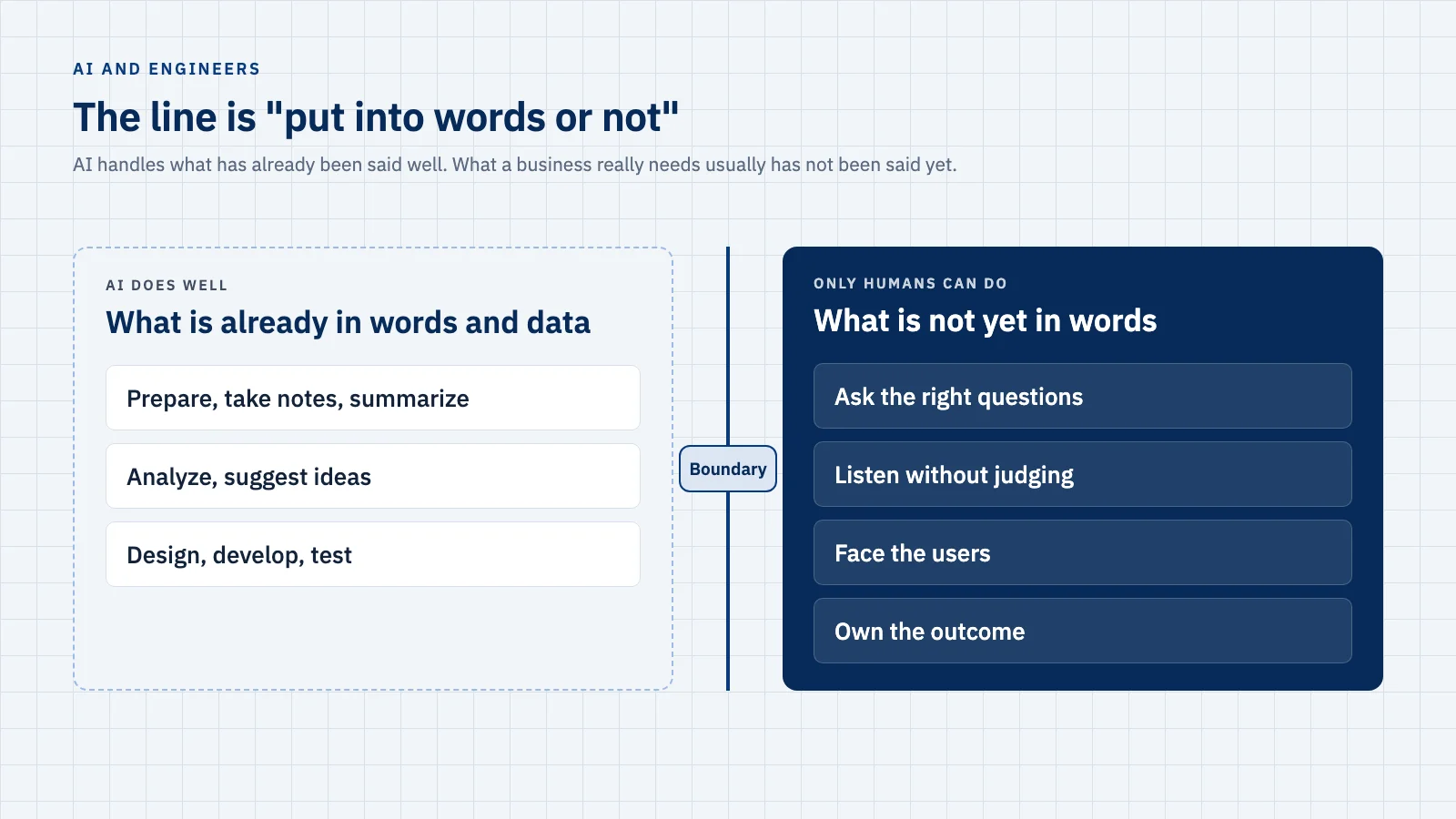
What AI does well: processing what is already in words
- Preparing, note-taking, summarizing: researching the company in advance, writing minutes, summarizing sessions.
- Analyzing, generating ideas: reading data, comparing options, suggesting directions.
- Design, development, testing: turning clear requirements into working software.
What only people can do: touching what is not yet in words
- Asking questions: what is unclear only becomes words when someone asks. A well-timed question such as “what good comes out of solving this?” can reveal the business goal behind a technical requirement.
- Listening without judgment: only when people do not fear being evaluated do they speak honestly about how things are done today, including the parts that do not make sense.
- Facing the users: changing how work is done is a human matter. Someone has to accompany users until they understand and agree to change.
- Taking responsibility for the result: AI can produce options, but it does not take responsibility for them. The company needs a person who stands up and takes responsibility until there is a result.

The role that takes on this part: the FDE
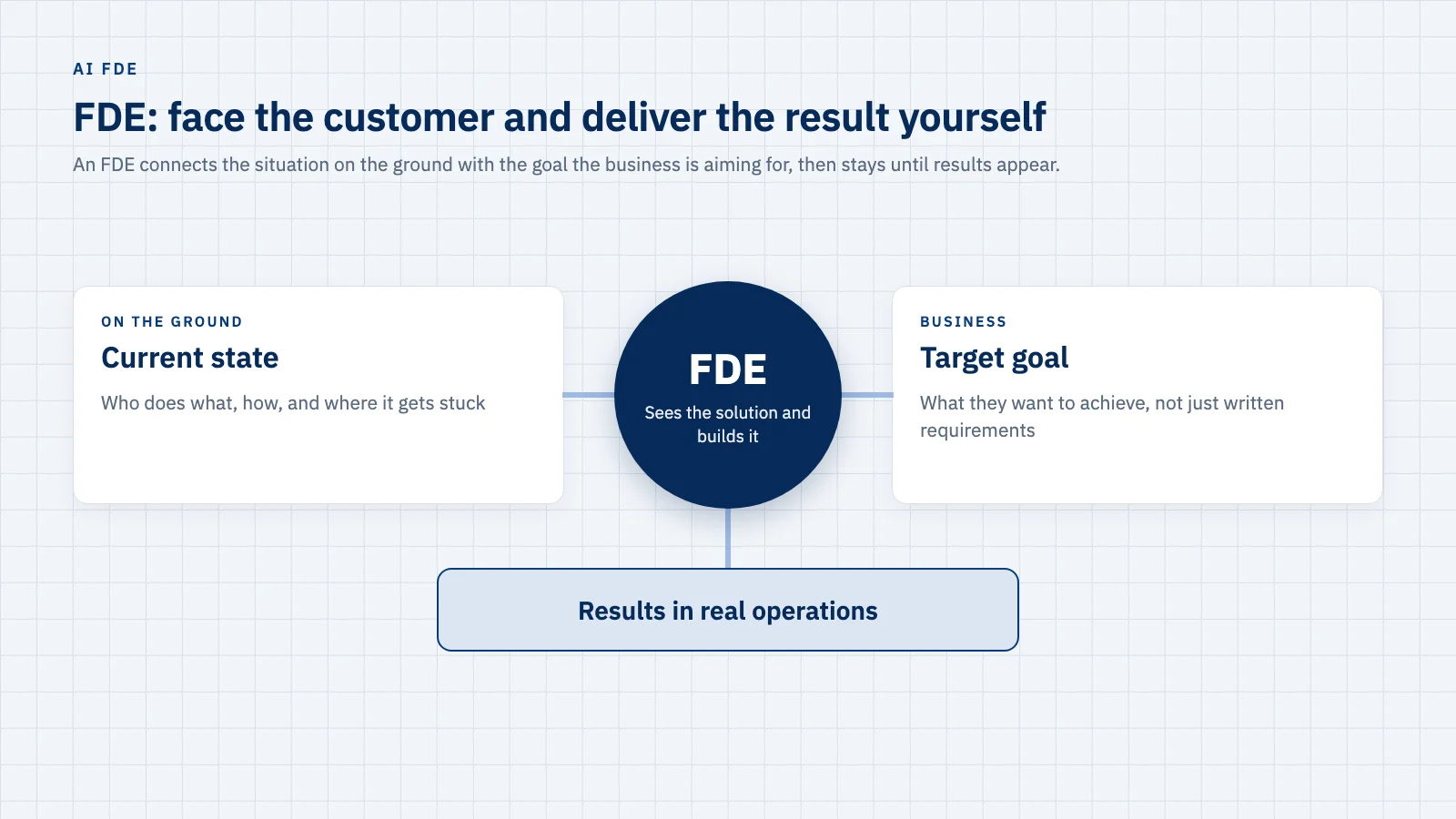
The role created to take on exactly this part of the value is the FDE (Forward Deployed Engineer): the person who faces the customer and builds what produces results.
Concretely, the FDE does four things in one continuous flow:
- Understands the goal the company is aiming for, not just the written requirements.
- Understands the reality on the front line: who is doing the work, how, and where they get stuck.
- Sees the valuable solution that connects the two points, and turns it into something tangible using AI and other tools.
- Accompanies the work until there are results, not stopping at hand-over.
AI helps the FDE do the “building” part much faster, so the FDE can bring a draft or mock-up right after a conversation for the company to review and correct. Correcting something you have been shown is much easier than describing it from zero. The time saved by AI goes into exactly the part AI cannot do: asking, listening, deciding and accompanying users.

To see how an FDE differs from a development contractor, a Bridge SE or IT consulting, read Contractor, Bridge SE, IT consulting or FDE? The definition and origin of this role are in What is an FDE?
How should a company look for engineers in the AI era?
When choosing a team or partner for a software or AI project, coding skill is still needed but is no longer what sets them apart. Better questions to ask:
- What do they ask in the first session? About features, or about business goals and who will use it every day?
- Do they ask to meet real users? Or do they only work with the project owner?
- How early do they show a draft? With AI, a few days is enough to have something to correct.
- Do they dare to say “this part doesn’t need to be built yet”?
- How far does their responsibility go? To acceptance, or to results in operation?
At TMI Soft, AI FDE engineers are trained first in how to stand in front of a customer: seriously studying the company, letting the customer be the one who speaks and decides, looking beyond the system to the users and how it is operated, and only then technology. If you are not sure which problem to start with, see also Where should a business start with AI?
References
- Gergely Orosz, What are Forward Deployed Engineers, and why are they so in demand? (The Pragmatic Engineer, 08/2025).
- Joe Schmidt, Trading Margin for Moat: Why the Forward Deployed Engineer Is the Hottest Job in Startups (a16z, 06/2025).
If your company has a difficulty it cannot yet put a name to, a short conversation with a TMI AI FDE engineer can be the first step toward turning it into a clear problem.
Frequently asked questions
Now that AI can write code, do companies still need engineers?
Yes, but the role changes. AI does the coding, design and testing much faster. Engineers need to do what AI cannot do for them: find the right thing the company needs, decide what to do, accompany users and take responsibility for the result.
Which parts of a software project can be handed to AI?
Work that processes information already in words or data: preparing and summarizing sessions, analyzing data, generating ideas, design, coding and testing. Asking questions to clarify needs, making decisions and taking responsibility still need people.
Why do many systems that meet the requirements still go unused?
Because written requirements often do not reflect everything the company truly needs. Real needs live in working habits and have not been put into words. If nobody asks and goes to meet the users, a system easily meets the requirements but misses the need.
How does an FDE differ from a software engineer who knows how to use AI?
An engineer who knows how to use AI does the assigned work faster. An FDE takes on broader responsibility: facing the customer to understand goals and reality, deciding what to do, building the solution with AI and other tools, then accompanying the work until there are results in operation.