What Is an FDE (Forward Deployed Engineer)? Role and Responsibilities of the Engineer Deployed on Site
TMI Soft team, AI FDE Engineer6 min read

Quick summary
An FDE (Forward Deployed Engineer) is an engineer “deployed” right next to the customer’s team: they directly study the business problem, design the solution, write code, integrate with existing systems, and stay until the solution runs in real operations. The model was pioneered by Palantir and is now widely adopted by AI companies such as OpenAI, because the biggest gap in AI today is not the model but getting the model into daily workflows.
Key takeaways
- An FDE is an engineer who works directly with the customer, not just someone who writes code to a request
- The FDE’s focus is “one customer, many capabilities”, the opposite of a product engineer’s “one capability, many customers”
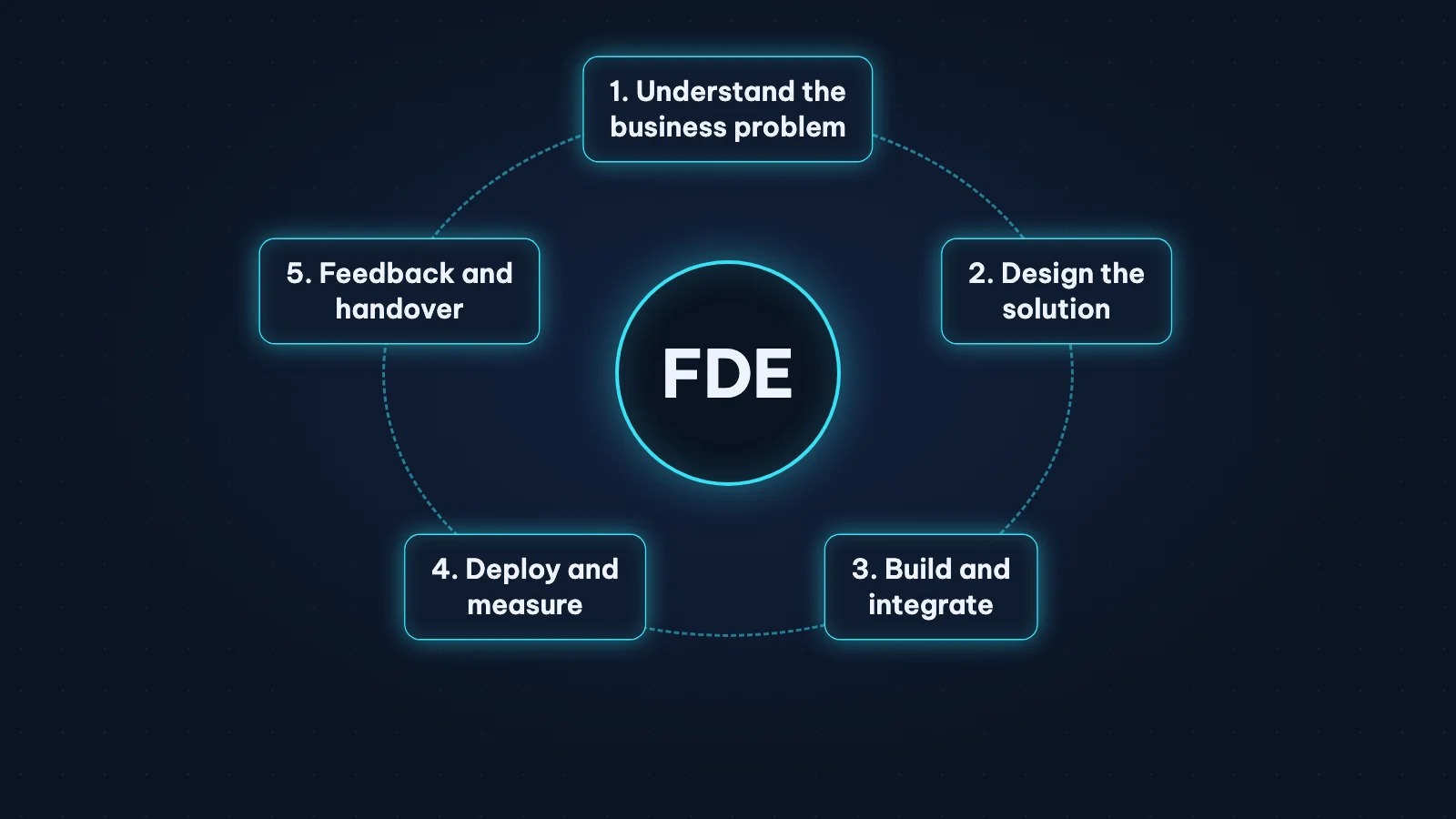
- Main responsibilities: understand the problem, design, build and integrate, deploy and measure, feedback and hand over
- FDEs are in demand because companies need people who turn AI into measurable value, not just a demo
Lately the term FDE (Forward Deployed Engineer) has appeared more and more in job postings at AI companies and in discussions about digital transformation. Many companies in Vietnam are not yet familiar with the role, even though it is the piece that decides whether an AI project stops at a demo or runs in real operations.
This article explains what an FDE is, why the role emerged, what an FDE is responsible for, and what a company gains from working with an FDE team.
What is an FDE?
A Forward Deployed Engineer is a software engineer who is “deployed” right next to the customer’s team. Instead of sitting in the vendor’s office and writing code to a specification, an FDE works directly with users to understand the business problem, design the solution, build it, integrate it, and put the system into real operation.
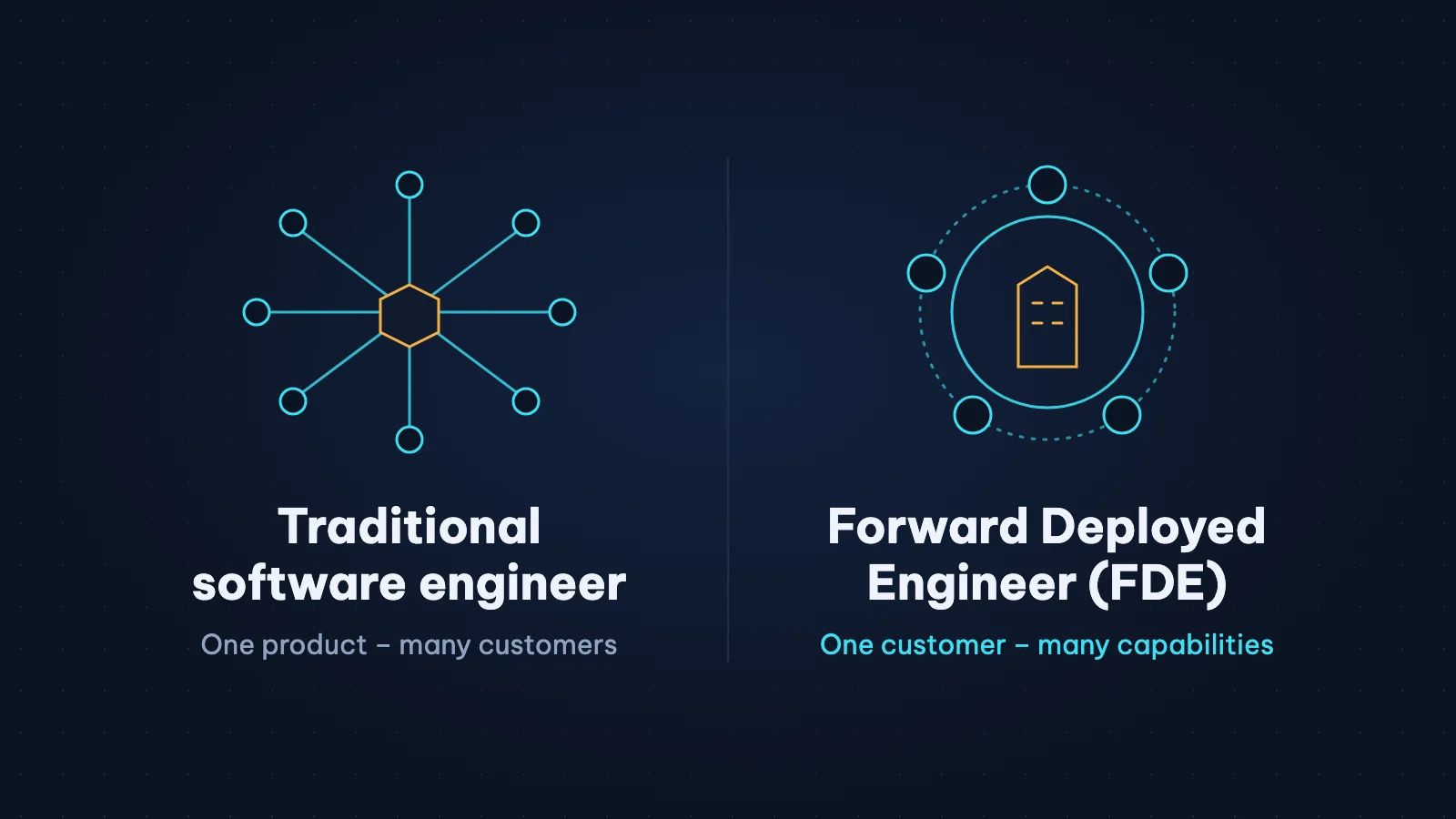
Gergely Orosz (The Pragmatic Engineer) sums up the difference in a memorable line: product engineers focus on “one capability, many customers”, while FDEs focus on “one customer, many capabilities”. A product engineer makes one feature work well for thousands of users; an FDE combines many capabilities to fully solve the problem of one specific customer.
Where does FDE come from?
The FDE model was pioneered by Palantir in the early 2010s. Palantir’s first customers were government agencies, whose needs could not be fully described through an ordinary product discovery process. The only way to understand the problem was to send engineers to sit with the users.
At Palantir, the role was originally called “Delta” internally. According to The Pragmatic Engineer, there was a period when Palantir had more FDEs than traditional software engineers, until the Foundry platform emerged around 2016. What FDEs built for individual customers was gradually distilled into a shared product.
Today the model is widely adopted by AI companies. OpenAI has its own Forward Deployed Engineering team, and many AI startups hire FDEs among their very first employees.
Why are FDEs in demand?
In 2025, the investment firm a16z called the FDE “the hottest job in startups”. The reason: for complex AI applications, packaged software rarely runs by itself inside a company. Someone has to sit with the customer to clean data, connect systems, adjust processes and measure results. a16z argues that this investment buys a lasting competitive advantage (“trading margin for moat”): a solution tightly embedded in the customer’s operations is hard to replace.
According to Lenny Rachitsky’s State of the tech job market: late 2026, open FDE positions have risen about 4.6 times compared with a year ago, while open software engineer positions grew only about 2.5%.
In Vietnam the picture is similar. The Unlocking Vietnam’s AI Potential 2026 report published by AWS says nearly 245,000 businesses in Vietnam are applying AI, but most are still at the experimental stage. At CIO Vietnam 2026, a survey presented by EY Vietnam showed that 74.8% of companies had experimented with AI or gone further, but only 6.3% could prove value in most of their AI initiatives.
In other words, companies do not lack people who know how to use AI. What they lack is people who turn AI into solutions that run, can be measured, and create real business value. That is the gap the FDE fills.
Role and responsibilities of an FDE
An FDE’s job does not stop at writing code. An FDE typically owns the whole lifecycle of a solution, from when the problem is still vague until the customer’s team can run it on their own.
1. Understand the business problem
The FDE goes to the front line, observes how staff currently work, and talks to users and decision-makers. The goal is to answer: what is the real problem, how much time and cost does it consume, and what result counts as success (the KPI).
2. Design the solution
From the problem, the FDE proposes a solution that fits the existing data and infrastructure: which AI model to use, what software is needed alongside it, and which infrastructure to run on to meet security requirements. Not every problem needs AI; sometimes a simple automated process is enough.
3. Build and integrate
The FDE writes the code: processing data, connecting to ERP, CRM or other internal systems, building user screens, permissions and audit trails. This is the big difference from a consulting role: the FDE is responsible until the system runs.

4. Deploy and measure
The solution is first put into the real process on a small scope, measured against the agreed KPIs, then improved in short loops with users. The FDE stays on site to handle the cases a demo never meets.
5. Feedback and hand over
The FDE brings what was learned on site back to the product team, so the solution keeps getting better for later customers. At the same time, the FDE trains the customer’s internal team so they can operate and adjust it when the business changes, instead of depending on the supplier.
How does an FDE differ from familiar roles?
| Criterion | Software engineer | Solutions engineer / Presales | Consultant | FDE |
|---|---|---|---|---|
| Where they work | Company office | Before the contract is signed | Periodic meetings with the client | Together with the customer’s team |
| Output | Product features | Demos, proposed solutions | Reports, roadmap | A system running in operations |
| Writes code? | Yes | Little | No | Yes, at production level |
| Success measured by | Product quality | Contracts signed | Recommendations accepted | The customer’s business KPIs |
Skills an FDE needs
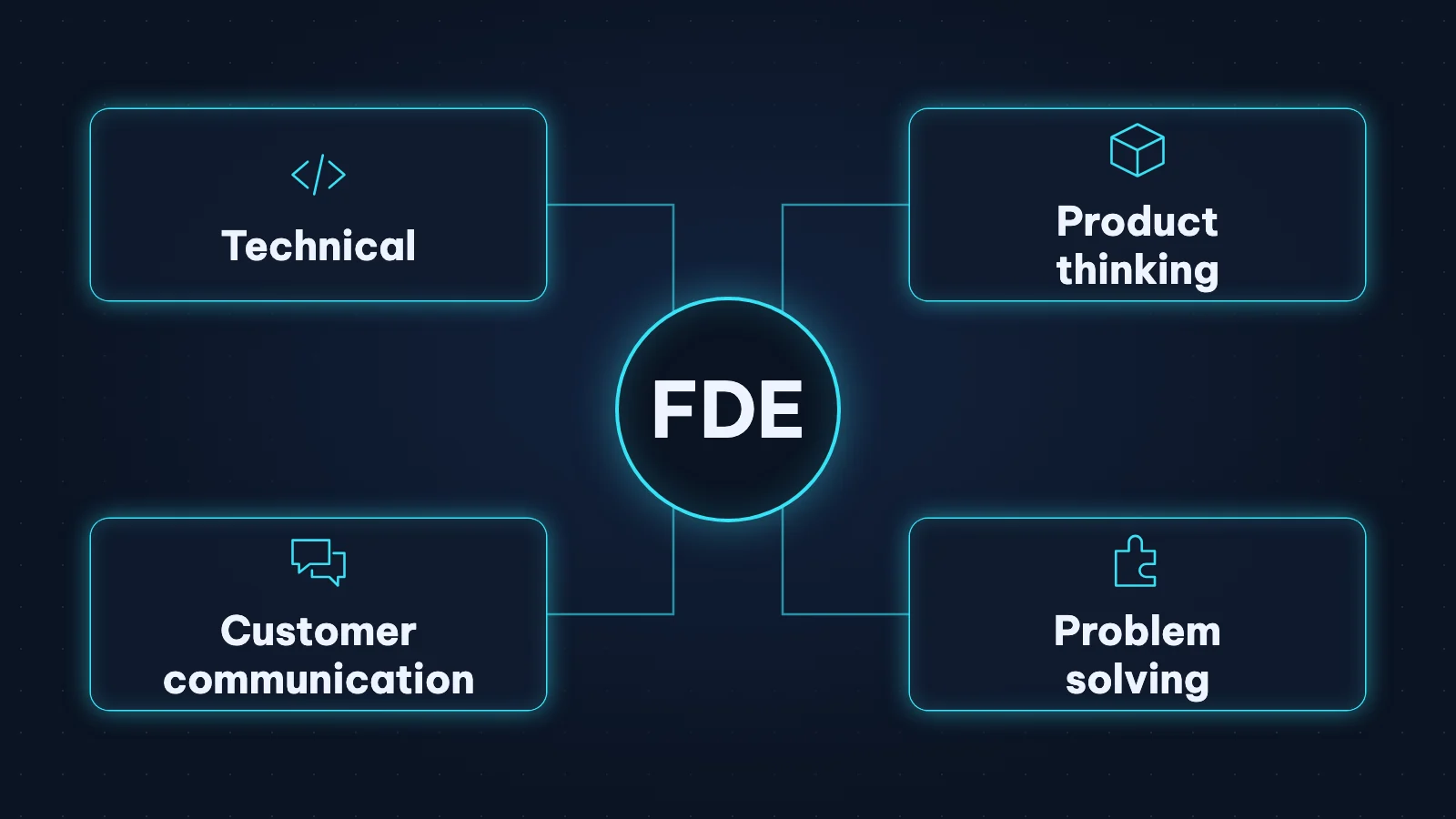
- Strong technical skills: programming, data processing, system integration, and a practical understanding of how to use AI models.
- Product thinking: knowing what to build, and prioritizing what creates value over what is technically interesting.
- Customer communication: able to talk with both operations staff and leadership, explaining technology in business language.
- Problem solving: comfortable with ambiguity, able to find the real problem when the initial request is unclear.
What does a company gain from working with an FDE?
For a company without its own AI team, working with an FDE directly addresses the common reasons AI projects stop at the demo:
- No gap between IT and the front line: the people who build the solution sit next to the people who use it.
- Measurable results: every change follows the business KPIs agreed from the start.
- No dependence on the supplier: the internal team is trained to operate and improve it themselves.
- No need to hire an expensive AI team right away: the company gets AI engineering capability when needed, for the problem that needs solving.

At TMI Soft, AI FDE engineers work in exactly this spirit: choosing the problem with the company’s team, validating on real data, improving until the KPIs are met, then handing over so the internal team can run it. See the detailed roadmap in Where should a business start with AI?
References
- Gergely Orosz, What are Forward Deployed Engineers, and why are they so in demand? (The Pragmatic Engineer, 08/2025).
- Joe Schmidt, Trading Margin for Moat: Why the Forward Deployed Engineer Is the Hottest Job in Startups (a16z, 06/2025).
- Lenny Rachitsky, State of the tech job market: late 2026 (Lenny’s Newsletter).
- VnEconomy, Nearly 245,000 Vietnamese businesses are applying AI (on the AWS report Unlocking Vietnam’s AI Potential 2026; Vietnamese-language source).
- BBW, The AI wave has yet to prove profitability at Vietnamese companies (EY survey at CIO Vietnam 2026; Vietnamese-language source).
If your company has a problem you want to try with AI but does not know where to start, a short conversation with a TMI AI FDE engineer can help identify a suitable starting point.
Frequently asked questions
What does FDE stand for?
FDE stands for Forward Deployed Engineer: a software engineer who works directly with the customer’s team to build a solution and put it into real operation.
How does an FDE differ from an ordinary software engineer?
A software engineer usually focuses on one feature for many customers. An FDE focuses on one customer and combines many capabilities (business analysis, programming, integration, deployment, training) to fully solve that customer’s problem.
How does an FDE differ from a consultant or presales?
Consultants and presales mainly make recommendations or demos. An FDE writes production-level code and stays responsible until the system runs in the real process, measured by the customer’s business KPIs.
Does a small business need an FDE?
A company does not necessarily need to hire an FDE full time. It can work with a partner’s AI FDE team during problem selection, validation and deployment, then receive a hand-over so internal staff can run it themselves.
Why has the FDE become common in the AI era?
AI models keep getting more powerful, but the hard part is bringing AI into each company’s own data, systems and processes. The FDE fills that gap, turning AI into a solution that works and can be measured.