Rolling Out AI in the Enterprise: 5 Leadership Concerns and Where to Start Addressing Them
TMI Soft team, AI FDE Engineer8 min read
Quick summary
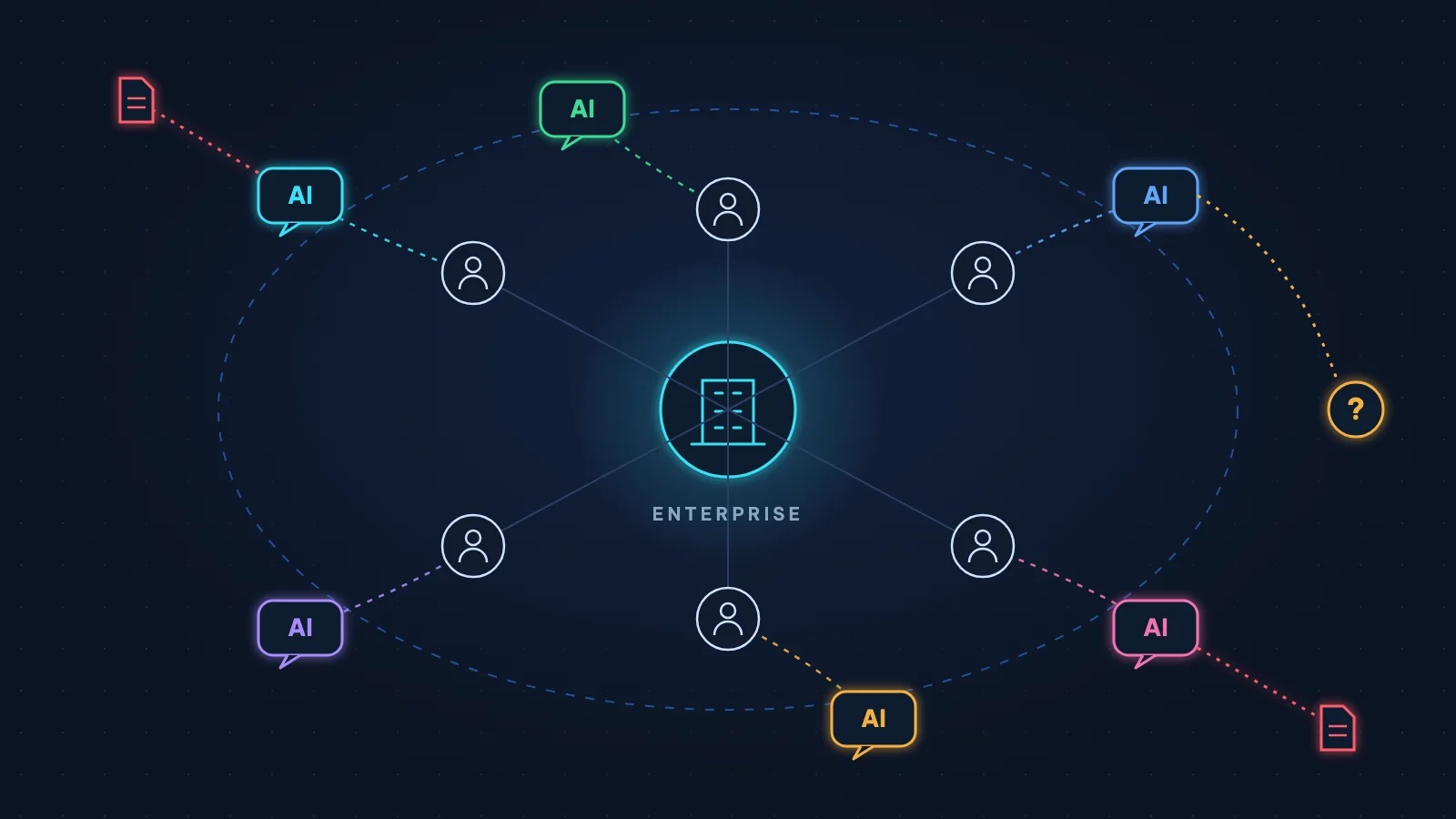
When asked to “look into and roll out AI”, most companies do not start from zero: employees have been using AI on their own for a long time. So the common concern is not “should we use AI”, but this: everyone uses it differently and so it is ineffective, data leaves the company without control, and AI output is submitted or sent to customers without anyone checking it. At the same time, the company still wants to use AI to cut errors and costs and not be left behind by competitors. A sensible approach follows an order: understand the current state, set common rules and tools, then pick a few repetitive tasks to standardize and measure.
Key takeaways
- Employees were using AI before the company had a policy: Microsoft found that 78% of AI users bring their own tools to work
- Three concerns happening now: everyone uses it differently, data leaves the company, AI output is not checked
- Two pressures ahead: the need to cut errors and costs, and competitors using AI to be faster and cheaper
- The company is responsible for what AI produces, even when the error comes from AI
- The first 30 days: survey the current state, issue a one-page policy with company accounts, pick 1–2 repetitive tasks to standardize and measure
“The company needs to look into and roll out AI.” Many directors and department heads are receiving this request from senior management or from a parent company overseas. The first question that comes to mind is: where do we start?
What is easy to overlook is that a company almost never starts from zero. Microsoft and LinkedIn’s 2024 Work Trend Index, a survey of 31,000 people in 31 countries, found that 75% of knowledge workers already use AI at work, and 78% of them bring their own AI tools to work without waiting for the company to provide them. Only 39% of users have been trained on AI by their company.
In other words, AI is already inside the company, just not managed by anyone. From this reality come five concerns that leadership often raises: three about what is happening now, and two pressures about what is coming.
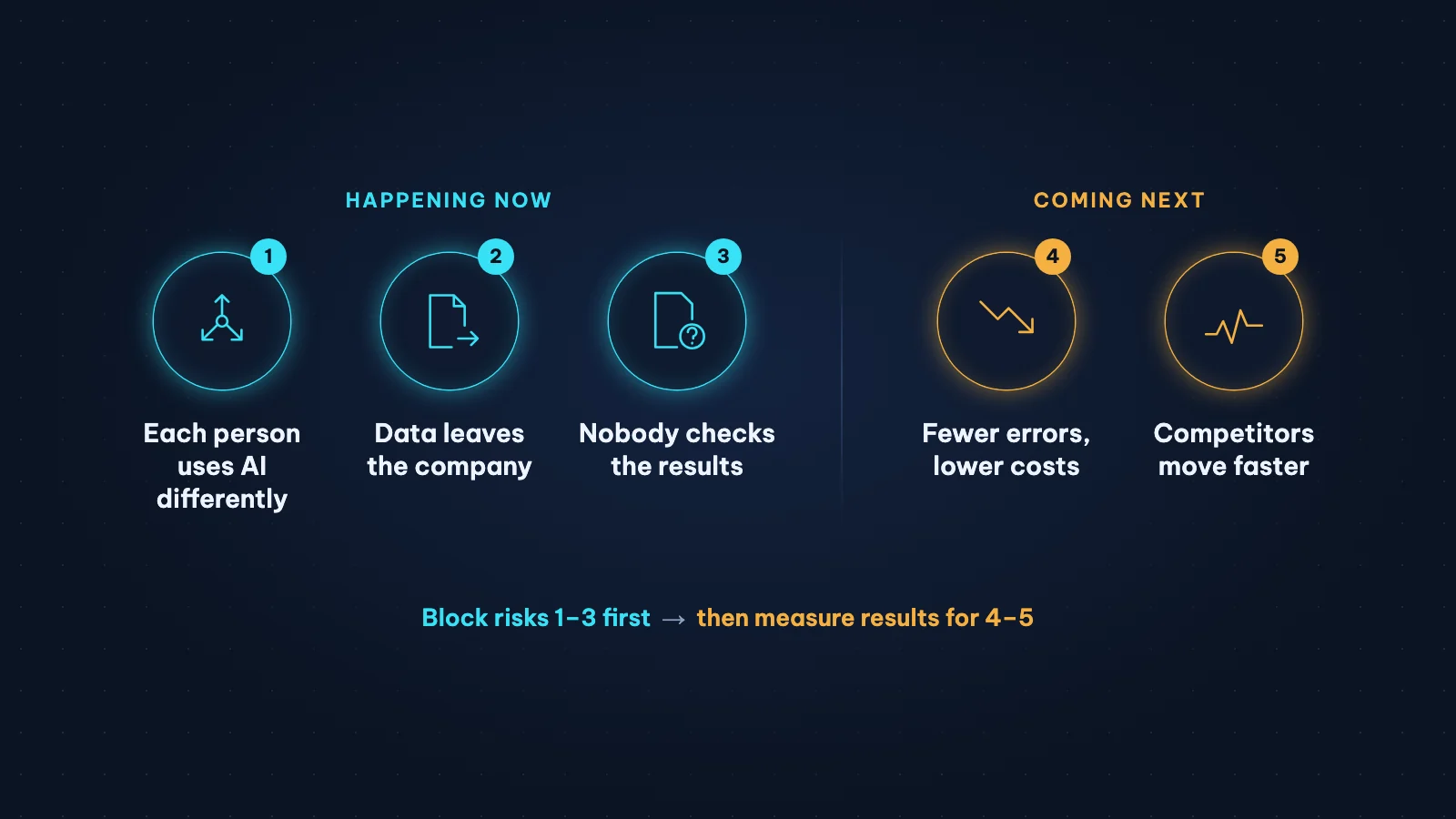
Concern 1: Employees use AI, but everyone does it differently
Some use the free version of ChatGPT, some use Gemini, some ask AI to write emails, some use nothing. People good at writing prompts work twice as fast; others try a few times, fail and give up. The result:
- Effectiveness sits in the hands of a few individuals. When that person leaves, the way of working leaves with them.
- The same type of document (quotes, minutes, reports) is produced in a different style by each person, making it hard for supervisors to check.
- The company does not know how much AI is helping, so it does not know whether it is worth investing more.
What to do: choose one shared tool for the whole company, then standardize how it is used for the few most repetitive tasks. For example, one prompt template for meeting minutes and one for replying to customer emails. Training tailored to the work employees actually do is far more effective than a general introduction to AI.
Concern 2: Data leaves the company without anyone controlling it
When employees paste contracts, drawings, customer lists or payroll into an AI tool using a personal account, the company does not know where that data goes or how long it is kept.
This is not a theoretical risk. In 2023, Samsung found that engineers in its semiconductor division had put internal source code and meeting notes into ChatGPT to get work done. After the incident, Samsung banned generative AI on company devices and networks. Microsoft also notes that employees bringing their own AI to work puts company data at risk.
In Vietnam, the Law on Personal Data Protection (Law No. 91/2025/QH15) takes effect on 1 January 2026. Customer and employee data is personal data, so putting it into an external AI tool is no longer just a matter of company rules. For companies with foreign capital, the parent company usually also has its own information security rules that the branch must follow.
What to do:
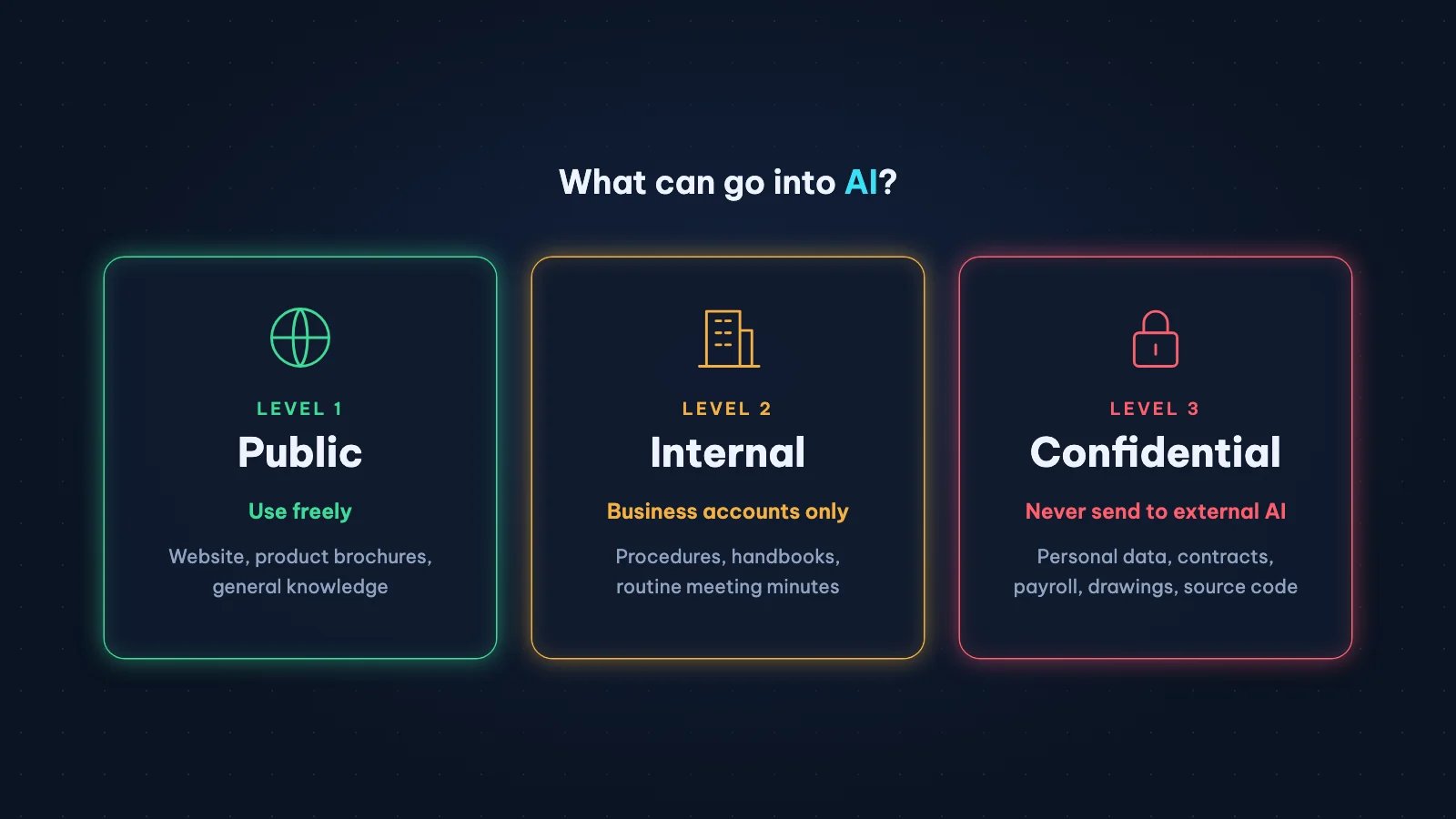
- Divide data into three levels: public (free to use), internal (only on company accounts), confidential (not to be put into external AI).
- Use company accounts instead of personal accounts. The business plans of the major AI tools have their own commitments not to use data for training and let administrators manage users; read each provider’s terms carefully.
- Issue a short policy, about one page, stating clearly what is and is not allowed. An outright ban is usually ineffective, because employees will switch to their personal phones.
Concern 3: AI output is submitted or sent to customers without anyone checking it
AI writes fluently and confidently, even when it is wrong. If users do not know how to check, or do not have time to check, the output goes straight up to supervisors or out to customers.
Two examples that became lessons:
- Deloitte Australia (2025) had to refund part of its fee to the Australian Department of Employment after a report worth about AUD 440,000 contained an incorrect quotation from a court judgment and cited academic sources that do not exist. The corrected version then stated that generative AI had been used in writing the report.
- Air Canada (2024) was ordered by a civil resolution tribunal in British Columbia (Canada) to compensate a customer because the chatbot on its website gave the wrong fare policy. The airline argued that the chatbot was responsible for itself, but the tribunal rejected that: a company is responsible for all information on its website.
What they share: customers do not care whether the error came from a person or from AI. The company is still the party responsible.
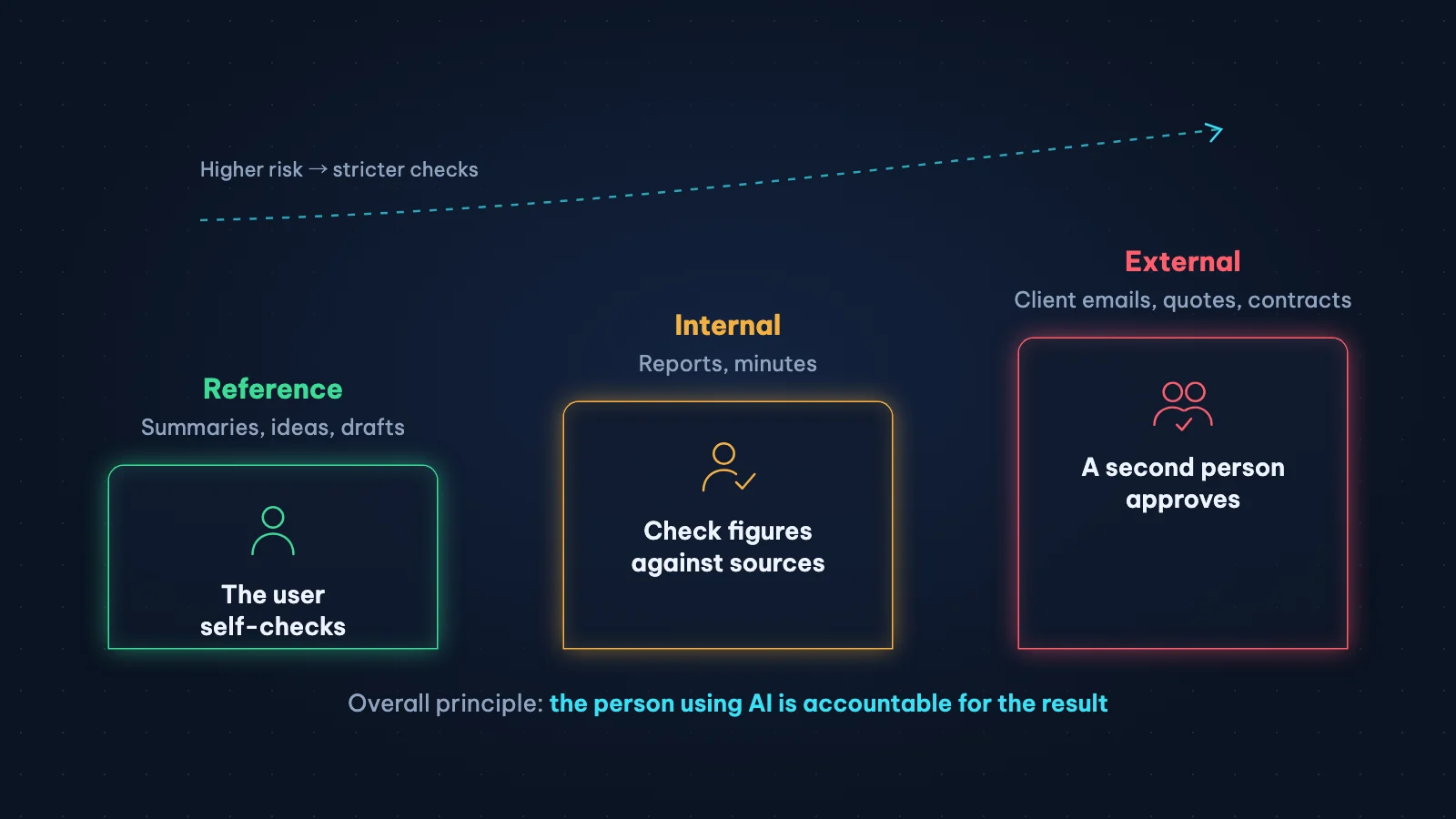
What to do: state clearly that “the person using AI is responsible for the result”, and set the level of checking by level of risk. For internal reference documents, a self-review by the author is enough. For anything sent to customers that contains figures, prices, terms or citations, a second person must review it and check the sources.
Concern 4: We want fewer errors and lower costs, but do not know how to measure
This is the main reason to invest in AI, and there is real evidence. A study by Erik Brynjolfsson (Stanford) and colleagues of more than 5,000 customer support agents found that with an AI assistant, the number of issues resolved per hour rose by about 14%, and new or less experienced agents improved the most, by about 34%.
But using AI does not automatically produce results. McKinsey’s State of AI 2025 survey shows that 88% of companies use AI in at least one function, but only about 39% can point to a measurable impact on profit. Most are still at the experimental stage.
What to do: choose work that is repeated many times and measurable, such as drafting quotes, checking documents, compiling daily reports, answering repeated questions. Measure before applying (how long it takes, how many errors), then measure again after a month. The before and after numbers are also what leadership or the parent company needs to see to approve the next step.
Concern 5: Competitors use AI and are getting faster than us
This pressure comes from outside. Newly founded companies, lean and flexible, use AI from day one to:
- Quote faster and present better, in hours instead of days.
- Respond to customers faster, even outside working hours.
- Analyze competitors and the market regularly instead of once a year.
- Understand the business and inventory better, spotting anomalies earlier.
There is one more change that gets little attention: customers are finding suppliers in a different way. Instead of searching on Google and clicking through each website, more and more people ask ChatGPT, Gemini or Copilot directly. Gartner once forecast that traffic from traditional search engines could fall 25% by 2026 because of chatbots and AI assistants. This is a forecast and many SEO experts consider it too strong, but the trend is clear: if a company’s information is not clear enough for AI to understand and cite, the company will be absent from the answers customers receive.
What to do: do not try to do everything competitors do. Choose the one point customers feel most clearly, usually quoting speed or response speed, and do that well first.
Summary: concerns, signs and the first thing to do
| Concern | Signs in the company | First thing to do |
|---|---|---|
| Everyone uses AI differently | Effectiveness depends on a few individuals; documents are inconsistent | One shared tool; usage templates for 2–3 repetitive tasks |
| Data leaves the company | Employees use personal AI accounts for company work | Three-level data classification; company accounts; a one-page policy |
| Output goes unchecked | Reports and customer emails contain errors and it is unclear who is responsible | The AI user is responsible; two-layer review for anything sent outside |
| Fewer errors, lower costs | AI is used but nobody can say how much is saved | Choose repetitive work; measure before and after |
| Competitors are faster | Losing orders because quotes and responses are slow | Choose the one point customers feel most and improve it first |
What should the first 30 days look like?
If you have just been given the task of “looking into and rolling out AI”, the following three things both reduce risk right away and give you enough information to propose the next step:
- Run a quick survey of the current state. Who is using AI, which tools, for what work, and what data they put in. A 10-question questionnaire is enough. The results are often surprising.
- Issue a one-page policy and provide company accounts. Block data risk and output risk before expanding.
- Choose 1–2 repetitive tasks to standardize and measure. This is the first concrete result to report to leadership or the parent company.
For companies with foreign capital, structuring the report around exactly these five concerns is usually easy to get approved: the three risks that exist and how they have been controlled, plus the two opportunities and the measured result from the first trial.
After 30 days, the next step is to bring AI from personal tools into the company’s real processes. Where should a business start with AI? sets out the 4-step roadmap for this stage. If you want to know where your company stands, see Gartner’s 5-level AI maturity model. And if you are weighing whether to do it yourself or find someone to help, Outsourced Dev, BrSE, IT consulting or FDE? helps compare the options.
References
- Microsoft & LinkedIn, 2024 Work Trend Index: AI at Work Is Here. Now Comes the Hard Part (05/2024).
- The Japan Times (Bloomberg), Samsung bans ChatGPT and other generative AI use by staff after leak (05/2023).
- LuatVietnam, Full text of the 2025 Law on Personal Data Protection (Law No. 91/2025/QH15) (Vietnamese-language source).
- CFO Dive, Deloitte refunds Australian government over report with AI errors (10/2025).
- American Bar Association, BC Tribunal Confirms Companies Remain Liable for Information Provided by AI Chatbot (02/2024), the Moffatt v. Air Canada case.
- Brynjolfsson, Li & Raymond, Generative AI at Work, NBER Working Paper 31161 (2023).
- McKinsey, The state of AI in 2025: Agents, innovation, and transformation (11/2025).
- CMSWire, Will Search Engine Traffic Really Drop 25% by 2026, As Gartner Predicts? (2024), on Gartner’s forecast.
If you need to prepare an AI rollout proposal for senior management or the parent company, a short conversation with a TMI AI FDE engineer can help you quickly review the current state, identify the risks to block first, and choose the first worthwhile task.
Frequently asked questions
Where should a company start rolling out AI?
Start from the current state, because most employees are already using AI on their own. In the first 30 days, survey who is using which tool for what, issue a short policy together with company accounts, and pick 1–2 repetitive tasks to standardize and measure.
Should we ban employees from using ChatGPT?
A complete ban is usually ineffective, because employees will switch to personal devices and the company will have even less control. A more practical approach is to provide company accounts, classify which data may and may not be put into AI, and state clearly who is responsible for checking the output.
Is using AI with customer data against the law?
Customer and employee data is personal data, covered by the Law on Personal Data Protection (Law No. 91/2025/QH15), effective from 1 January 2026. A company needs to define clearly which data is processed with which AI tool and seek legal advice for specific cases.
If AI produces wrong output and it is sent to a customer, who is responsible?
The company. In Moffatt v. Air Canada (2024), the tribunal rejected the argument that the chatbot is responsible for itself and ordered the airline to compensate the customer. So outbound content with figures, prices or terms should be reviewed by a second person.
How can we prove AI helps reduce costs?
Choose a repetitive, measurable task, record the processing time and number of errors before applying AI, then measure again after about a month. The before and after numbers are the basis for leadership or the parent company to approve the next step.