Which AI Level Is Your Company At? Gartner’s 5-Level AI Maturity Model
TMI Soft team, AI FDE Engineer6 min read

Quick summary
Gartner’s AI maturity model divides the AI adoption journey into 5 levels: Awareness, Active, Operational, Systemic and Transformational. MIT research across 721 companies shows that the difference in financial performance appears when AI moves from experimentation into real operations. The simplest way to self-assess is to start from two questions: what decisions is the company making, and what data does it have.
Key takeaways
- Gartner divides the level of AI adoption into 5 levels: Awareness, Active, Operational, Systemic, Transformational
- Levels 1–2: AI is still in meetings and in the hands of a few individuals; level 3 and above: AI sits inside real processes
- MIT CISR (721 companies): the first two stages show financial performance below the industry average, the last two well above
- Self-assess with two questions: what decisions the company makes, and what data it has
- Avoid using AI because it is “hot”, declaring a breakthrough without a foundation, and skipping levels
“How far has our company gone with AI, and are we behind our competitors?” Many leaders ask this when they see everyone talking about AI. It is hard to answer, because “using AI” can mean one employee occasionally asking ChatGPT to write an email, or an entire sales process running on dedicated data and models.
An AI maturity model helps separate those two situations. It divides the journey of applying AI into levels, so a company knows where it stands and what the next step is. This article introduces Gartner’s 5-level model, one of the most frequently cited, and how to use it for your company.
What is an AI maturity model?
A maturity model is a tiered assessment framework. The low tiers are ad hoc work with unpredictable results. The high tiers have clear processes, are measurable and keep improving. For AI, the question is not “whether we use AI”, but how deeply AI has entered the way the company operates and creates value.
Gartner divides this into 5 levels: Awareness, Active, Operational, Systemic and Transformational.
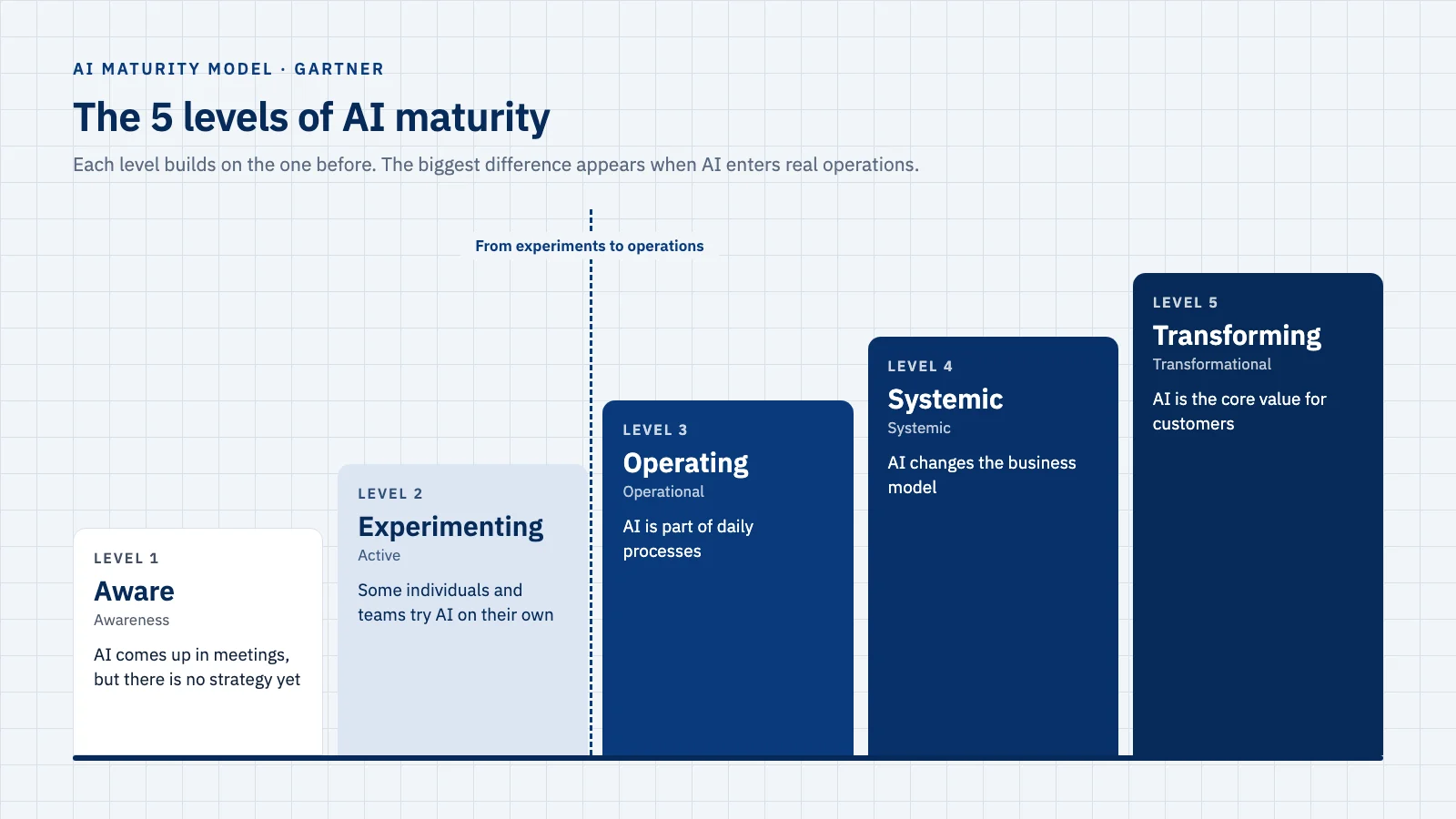
Gartner’s 5 levels of AI maturity
Level 1. Awareness
The company knows about AI and is excited about it, but is not really using it. At this level people often talk about AI more than they understand it. There are ideas but no strategy: it is unclear what to use AI for, how to measure effectiveness, and who is responsible.
Signs: AI appears in strategy meetings and speeches, but no project is tied to a specific process.
Level 2. Active
The company starts using AI informally: a few people and a few teams try tools and try some off-the-shelf models in their work. There are early results, but AI is not part of the shared process and depends on individual enthusiasm.
Signs: there are many demos and trials, but when the person doing the work moves on, most of them stop.
Level 3. Operational
AI becomes part of daily work. The company has people responsible for maintaining models, building data pipelines and managing data versions. The infrastructure for AI has been set up, and AI supports some information processing in operations.
Signs: if the AI system were switched off, a real process of the company would be affected.
Level 4. Systemic
AI is used in new ways to change the business model, not only to do old work faster. The difference from level 1, where people also like to talk about “breakthroughs”, is that a level 4 company has a real foundation: enough data, infrastructure and team to turn ideas into products.
Signs: there are products, services or ways of selling that can exist only thanks to AI.
Level 5. Transformational
AI is used everywhere, and the AI’s ability to process information is itself the value the company delivers to customers. Frequently cited examples are Google with search, Facebook with ranking posts and ads, and Amazon and Netflix with recommendation systems.
Signs: you cannot describe the company’s product without mentioning AI.
| Level | Where AI is | Question to answer to move up |
|---|---|---|
| 1. Awareness | In meetings | Which specific decision or task will we use AI for? |
| 2. Active | In the hands of some individuals | Which experiments are worth bringing into the shared process? |
| 3. Operational | In daily processes | Are data and infrastructure sufficient to do something new? |
| 4. Systemic | In the business model | Can AI become core value for customers? |
| 5. Transformational | Is the product itself | How do we keep and extend the advantage? |
BMC, which compiled this model, observes that most companies are still at level 1 and benefit from AI only lightly; very few reach level 5. This is an observation, not backed by a survey. For numbers, see the MIT research below.
Does moving up a level really make a difference?
MIT’s Center for Information Systems Research (MIT CISR) surveyed 721 companies and built a 4-stage AI maturity model, with different names but the same direction: from experimenting and preparing, to piloting and building capabilities, then bringing AI into ways of working, and finally being ready for the future with AI. The share of surveyed companies at each stage was 28%, 34%, 31% and 7% respectively.
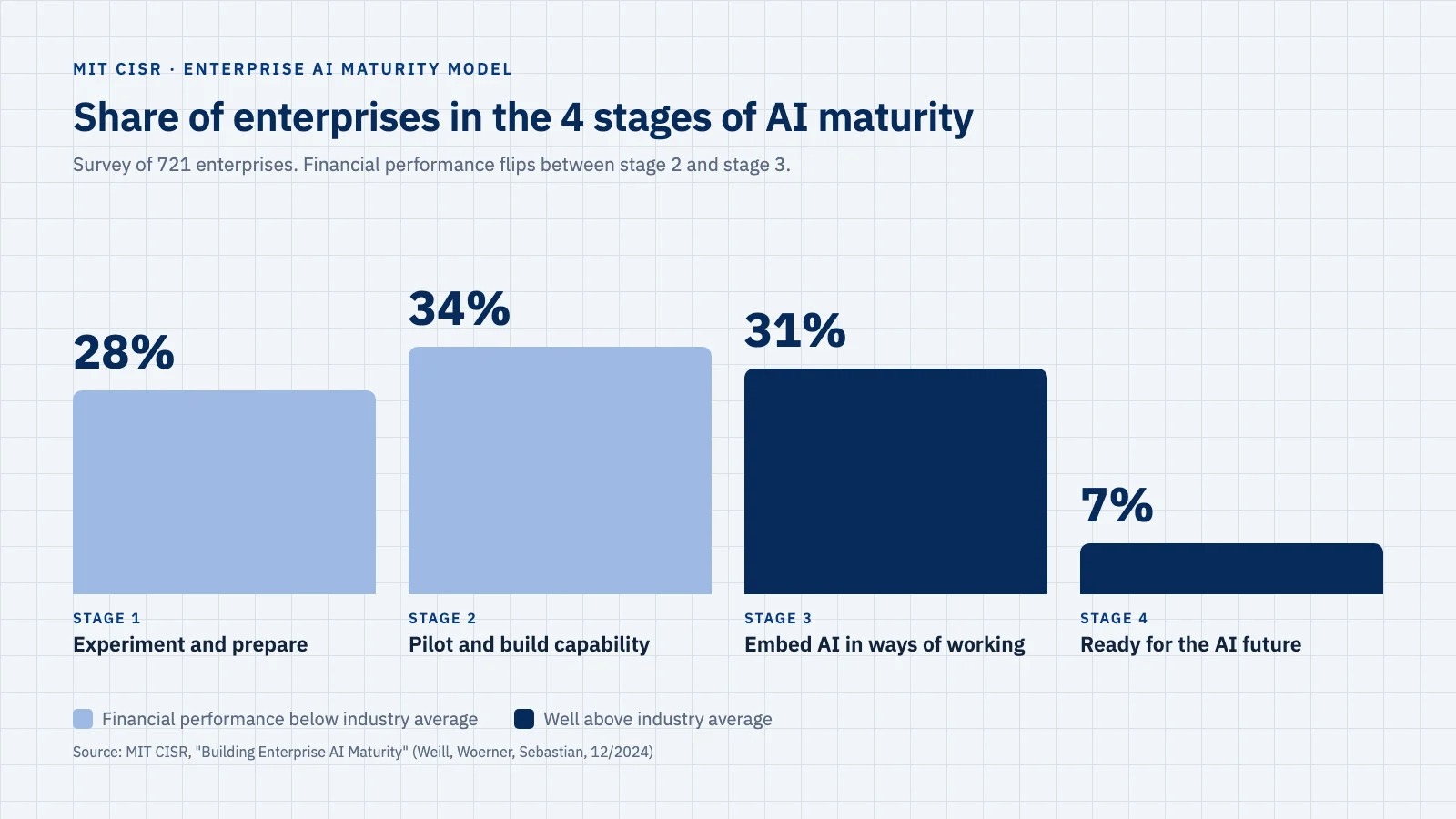
The most notable finding: companies in the first two stages had financial performance below the industry average, while companies in the last two stages performed well above the industry average. In other words, the boundary that makes the difference lies in the move from “experimenting” to “operating”. It is also the hardest step, because it requires changing processes and people’s habits, not just buying more tools.
Self-assessment: start from decisions and data
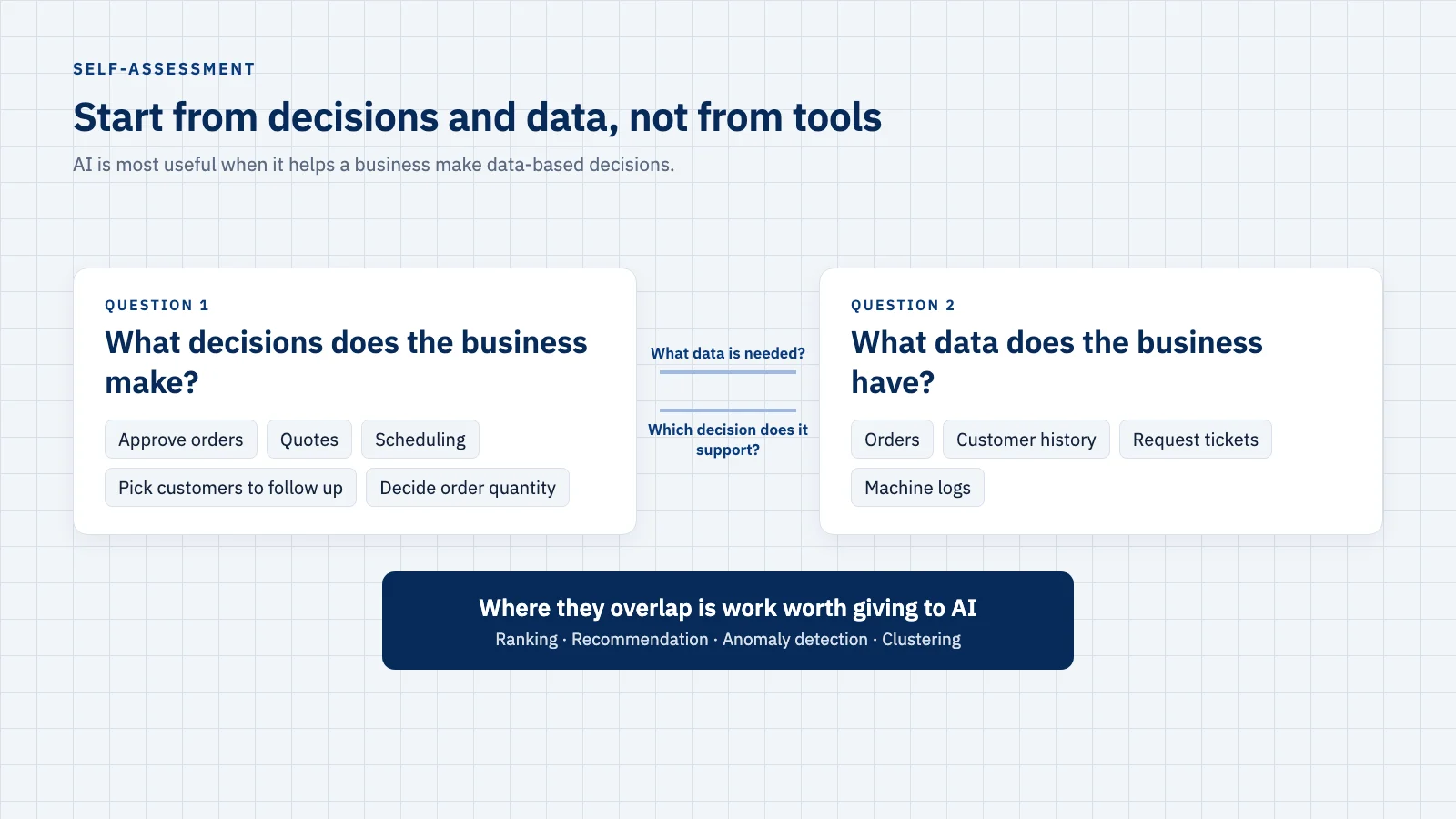
According to BMC, AI is most useful when it helps a company make decisions based on data. So instead of asking “which AI tool should we buy”, start with two questions:
- What decisions is the company making? Approving orders, quoting, scheduling, choosing which customers to nurture, how much stock to order…
- What data is the company collecting? Orders, customer history, request tickets, machine logs…
If you have data, ask: which decisions can this data support? If you have decisions, ask: what data does this decision need?
After that, BMC suggests a two-step process repeated continuously:
- Review how work is done today to find where AI can help, especially repetitive decisions. Automating these decisions lets the team do more without necessarily hiring more people.
- Think up new decisions that make the company more valuable, for example recommending the right product to each customer, or segmenting customers to set separate pricing policies.
The kinds of work AI usually does well: ranking (prioritizing customers, orders), recommending (products, content), detecting anomalies (transactions, machine faults) and segmenting (customers, products).
Three common traps
- Using AI because AI is “hot”. Without tying it to a specific decision or task, value is very hard to measure.
- Declaring a breakthrough without a foundation. Talking about transforming the business model while data is still scattered across Excel files is a sign of level 1, not level 4.
- Wanting to skip levels. Each level builds on the previous one. Skipping the step of bringing AI into operations to start a big project right away often leads to systems that are finished but not used.
From experimenting to operating: the step where many companies get stuck
Many Vietnamese companies are between level 1 and level 2: employees already use ChatGPT or other AI tools, there are a few demos, but no process truly runs on AI. To reach level 3, a company needs someone who understands both the front line and the technology: finding the right decisions worth giving to AI, building a trial directly on real data, and accompanying users until the new way of working becomes habit.
That is the role of the FDE (Forward Deployed Engineer). If you are weighing whether to work with a contractor, a consultant or an FDE, you can also read Contractor, Bridge SE, IT consulting or FDE? And if you do not know which problem to start with, Where should a business start with AI? is a good starting point.

References
- BMC Software, Gartner's AI Maturity Model: Maximize Your Business Impact (updated 01/2025).
- Gartner, The CIO's Guide to Artificial Intelligence (the source of the 5-level model cited by BMC).
- MIT CISR, New MIT CISR Research Finds Companies with Advanced Enterprise AI Outpace Industry Peers in Financial Performance (12/2024), the “Building Enterprise AI Maturity” study by Peter Weill, Stephanie Woerner and Ina Sebastian.
If you want to know which level your company is at and what the next step should be, a short conversation with a TMI AI FDE engineer can help identify the starting point and the first problem worth tackling.
Frequently asked questions
What is an AI maturity model?
It is a tiered assessment framework that shows how deeply AI has entered the way a company operates and creates value. Gartner’s model has 5 levels: Awareness, Active, Operational, Systemic and Transformational.
How do we know which level our company is at?
Look at where AI sits: only in meetings (level 1), in the hands of some individuals (level 2), in daily processes (level 3), in the business model (level 4), or is the product itself (level 5). A simple test: if you switch off the AI tools and no process is affected, the company has not reached level 3.
Do small and medium-sized companies need to reach level 5?
Not necessarily. Level 5 is for companies where AI is the core value sold to customers. For most companies, the realistic goal is to bring AI into real operations (level 3) for the important decisions and tasks.
Does moving to a higher level improve business performance?
MIT CISR’s study of 721 companies found that companies in the first two stages had financial performance below the industry average, while those in the last two stages were well above the industry average.
Where should we start to move up a level?
Start with two questions: what decisions is the company making, and what data is it collecting. Then pick a repetitive decision that already has data, build a trial on real data, and bring it into the process together with users.